PROTAC-Mediated α-Synuclein Degradation
By: Arjun Chunduri

Arjun Chunduri
Monte Vista High SchoolThrough this program, I honed my skills in both data discovery and analysis. I learned how to find, assess, valid data sources and apply analytic methods to make them meaningful. I significantly improved my ability to work with data that can be large and complex datasets, and feel like I gained a better understanding of how to scope a research problem with data in mind. At the same time, (and maybe most importantly), I feel confident now that I can conduct a research project in the future, based on the skills I have been practicing, and utilize it as a resource to search for information, analyze information, and create evidence-based conclusions.
Short Report
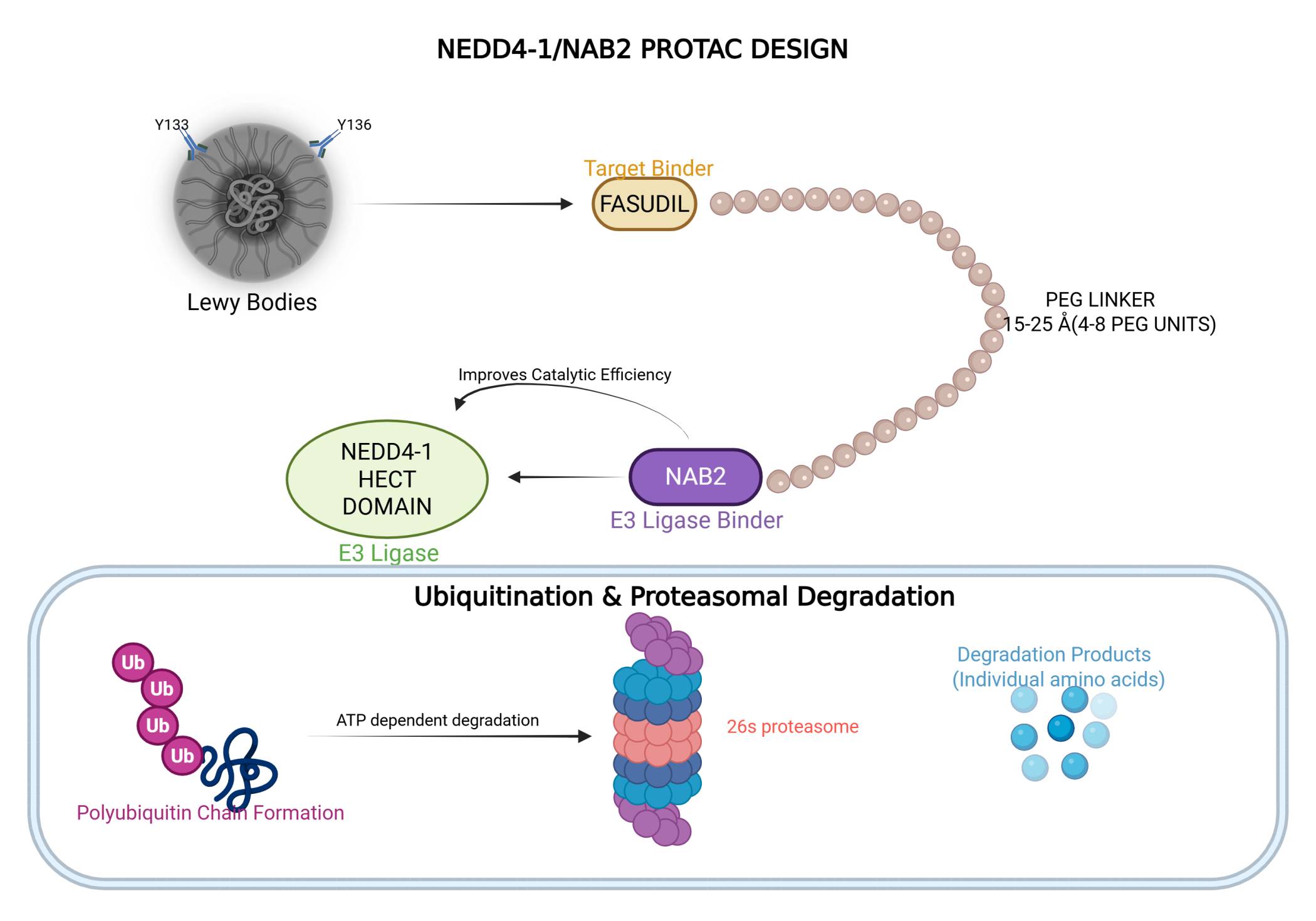
PROTAC Design
(Figure representation created by the author: Arjun Chunduri)
Background
Parkinson's disease (PD) is a neurodegenerative disease characterized by the death of dopaminergic neurons and the formation of α-synuclein aggregates called Lewy bodies. These aggregates interfere with mitochondrial and lysosomal function, exhibit prion-like spread between neurons, and drive progressive neurodegeneration. Current therapies such as L-DOPA target PD symptoms without halting disease progression or α-synuclein aggregation. Current treatments have been not successful in clearing aggregates, as both antibodies and small molecules have demonstrated limited success in the brain due to poor penetration and where Circulation in the blood was not associated with the target or drug not capable of clearing aggregates. In our project we will test a new approach to develop a new therapy for PD using a PROTACs targeting α-synuclein using the ubiquitin-proteasome system (UPS) for degradation, we propose to use a NEDD4-1/NAB2 based PROTACs system combined with Fasudil to obtain target specific degradation and neuroprotection.
Problem Statement
Parkinson's disease treatments currently provide symptomatic relief and do not address the underlying toxic α-synuclein aggregate that causes the disease. Traditional methods lack the efficacy to completely degrade these aggregates. The challenge is to generate a novel PROTAC-based strategy to selectively degrade α-synuclein providing true disease modification potential.
Research Hypothesis
I hypothesize that a NEDD4-1/NAB2-based PROTAC, with Fasudil acting as the α-synuclein binder, will be able to cause selective degradation of pathogenic α-synuclein aggregates. This two-pronged effort—amplifying activity from NEDD4-1 and providing targeted clearance—will reduce neurotoxic potential, mitigate aggregate spreading, and provide a disease modifying strategy for treating Parkinson's disease.
Results
The project produced a conceptual design for a new PROTAC in α-synuclein targeted degradation for the treatment of Parkinson's disease. Fasudil was chosen as the target-binding ligand because it binds α-synuclein at residues Y133, and Y136, plus it has established safety, neuroprotection and ability to cross the blood-brain barrier. As the E3 ligase component NEDD4-1 was chosen based on its established role in α-synuclein ubiquitination, while NAB2 was incorporated into enhance NEDD4-1's catalytic activity.
A PEG-based linker with a length of 15–25 Å was proposed that maintains the balance between flexibility and stability to support efficient ternary complex assembly. The designed PROTAC architecture facilitates α-synuclein binding via Fasudil, recruitment of the NEDD4-1 E3 ligase, and proteasomal degradation of toxic aggregates. The target degradation approach provides two important benefits: i) clear pathological protein species and ii) facilitates the independent neuroprotective effect of Fasudil for potentially dual synergistic therapeutic benefit when used together in patients. In conclusion, these findings support the development of PROTACs as a novel disease-modifying therapeutic strategy for the treatment of Parkinson’s disease.
Conclusion
This project illustrates the promise of PROTAC-based therapeutics in elevating the treatment of Parkinson's disease from merely symptomatic intervention to true disease modification. Combining Fasudil as the α-synuclein binder with NEDD4-1/NAB2 as the E3 ligase, the proposed PROTAC offers a novel dual mechanism: selective degradation of toxic α-synuclein aggregates and further neuroprotection conferred by Fasudil's independent neuroprotective properties. This rationale of targeting α-synuclein to address major shortcomings of current therapies—the inability to clear α-synuclein aggregates, the lack of control over disease progression and limitations associated with conventional inhibitors or antibodies—provides a compelling rationale for further exploration and experimentation. Though various challenges remain with optimizing linker design, blood-brain barrier penetration and preventing off-target effects, the umbrella framework present in this project provides an excellent platform for experimental development. If successful, then this therapeutic strategy is poised to usher in a novel strategy for treating Parkinson's disease by targeting the underlying protein pathology—as well as, potentially, other neurodegenerative diseases driven by protein misfolding and aggregation.
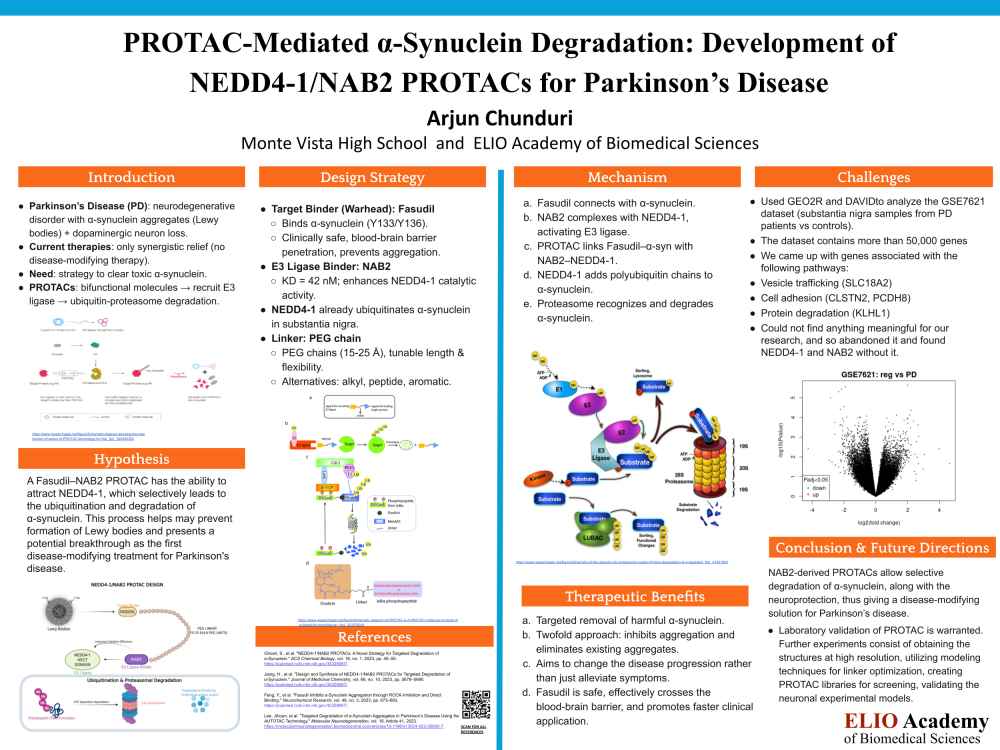
Full Report / White Paper
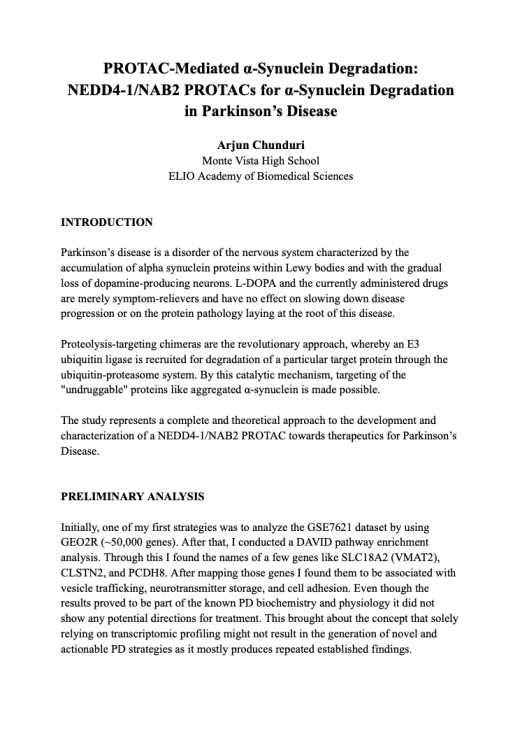
(Click to view the full report)
By: Arjun Chunduri. The opinions expressed here are the views of the writer and do not necessarily reflect the views and opinions of Elio Academy.