Transcriptomic and Pathway Characterization of the Alzheimer's Disease Hippocampus
By: Tanush Mysore and Oliver Wulf
Short Report
Summary
Alzheimer's disease (AD) is known to be the leading cause of dementia and is heterogeneous, ranging from rare early-onset familial forms to the much more common form with no single identified genetic cause. In both forms, the hippocampus is affected early, underlying the memory impairment that is a core symptom of the disease. There is no currently approved therapy that can completely reverse AD and its associated neurodegeneration, and at the same time, the specific transcriptional pathways involved in hippocampal degeneration in AD are incompletely characterized. This project analyzed differential gene expression in the GEO datasets GSE36980 (postmortem hippocampus, AD vs. non-demented control) and GSE1297 (Incipient Alzheimer's Disease: Microarray Correlation Analyses). We then tested the resulting gene lists from GSE36980 for pathway enrichment.
Two DEG lists were defined by nominal significance because no probe reached genome-wide FDR correction in this population. The 47-probe primary DEG list had a majority of downregulated annotated genes. We identified neuroactive ligand-receptor interaction and chemical synaptic transmission among the strongest enriched pathways, with GABAergic synapse and inhibitory synapse assembly also identified. A distinct metal-ion response cluster involving MT1F, MT1G, and MT1H was also found from the GO analysis. GSE1297 provided an independent hippocampal dataset of 31 samples, including 22 AD-spectrum samples and 9 controls. We then conducted a candidate-gene meta-analysis across GSE36980 and GSE1297 for six genes identified from the GSE36980 analysis: SST, CRHBP, AQP1, NPTX2, CALB1, and SCG2. We found that CRHBP had different directions between the two analyses, while the other five genes showed concordant directions. These results motivate validation of the five remaining genes in larger, independent patient cohorts as potential markers of hippocampal synaptic dysfunction.
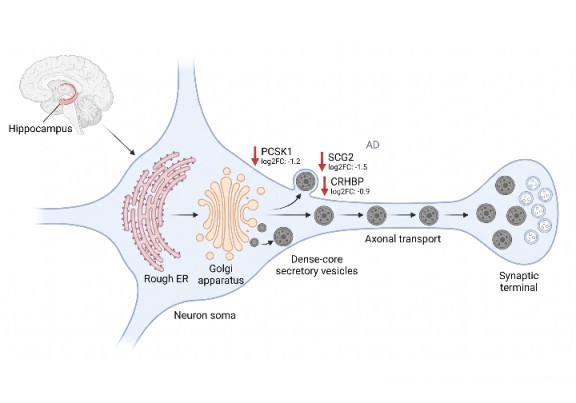
AD affected Dense-core secretory vesicle pathway in hippocampus neurons. The diagram shows the processing and formation of dense-core secretory vesicles and release at the synaptic terminal. THe red downloads arrows indicate reduced expression of PCSK1, SCG2 and CRHBP in AD.
(Figure representation created by the authors: Tanush Mysore and Oliver Wulf)
Background
Alzheimer's disease (AD) is the most common cause of dementia, typically causing memory and cognitive decline. The hippocampus is commonly affected early in AD, due to its involvement in learning and memory. AD is biologically heterogeneous, and although rare, early-onset familial AD is linked to mutations in certain genes: APP, PSEN1, and PSEN2; the more common cases are late-onset and are influenced by both genetic and environmental risks, such as APOE ε4. Molecularly, amyloid-β accumulation, tau pathology, synaptic dysfunction, neuroinflammation, and neuronal loss are all involved in AD. The currently available treatments cannot restore full function after neurodegeneration, identifying the gene expression changes in the vulnerable brain region can help generalize the disease mechanisms and could lead to future studies.
Problem Statement
Transcription pathways affected in the hippocampus during AD are incomplete, and individual gene expression studies are limited by small sample sizes and produce findings that do not replicate across data sets. Alzheimer's disease causes neurodegeneration in the hippocampus and knowing the gene expression changes and transcription pathways could improve early AD screening and treatment. The research problem we addressed was: Finding genes and pathways that are affected by Alzheimer's diseases, and if these expressions are consistent across multiple datasets?
Research Hypothesis
Using previous research and articles that we found, we hypothesize that hippocampal tissue from AD cases will show dysregulation of synaptic-transmission genes compared to the non-demented controls
Results
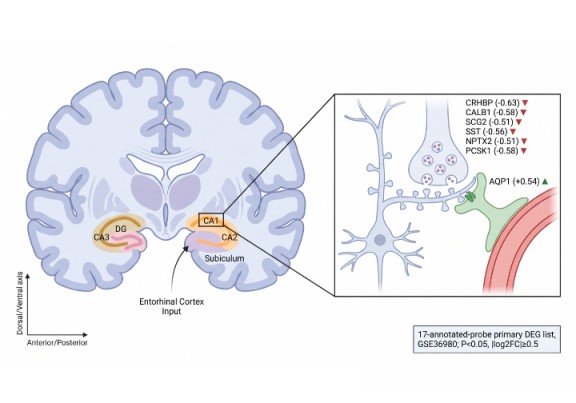
Gene expression changes in hippocampal subregions. The enlarged image depicts cellular localization of synaptic signaling and green glial cells, also separating upregulated and down regulated genes. Illustrates altered neuronal, synaptic glial associated gene expression in hippocampus.
(Figure representation created by the authors: Tanush Mysore and Oliver Wulf)
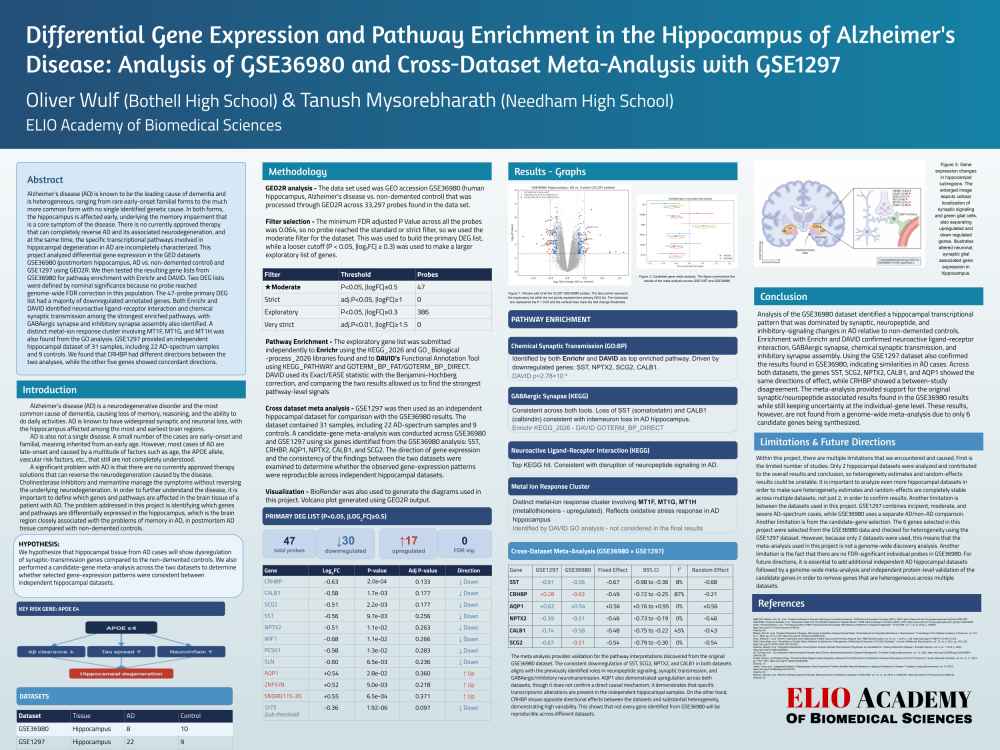
In GSE36980, no probe had genome-wide FDR significance, the smallest adjusted P value being 0.064. Using a moderate filter of P less than 0.05, |log2FC| ≥ 0.5, we identified 47 probes with the majority being downregulated genes. Notable genes were: CRHBP, CALB1, SCG2, SSt, NPTX2, and PCSK1, all being downregulated, while AQP1 was upregulated. Using an exploratory filter of P less than 0.05 and |logFC| greater than 0.3, 386 probes were used for enrichment analysis. We identify convergent pathway-level signals, we discovered neuroactive ligand-receptor interaction, chemical synaptic transmission, GABAergic synapse, inhibitory synapse assembly, and retrograde endocannabinoid signaling. Our analysis also found a distinct metal ion response cluster of three upregulated metallothioneins. Cross analysis of candidate genes using another data set: GSE1297, showed concordance directions for ⅚ genes: SST, CRHBP, AQP1, NPTX2, CALB. CRHBP was the 6th gene that showed opposite directions and high heterogeneity.
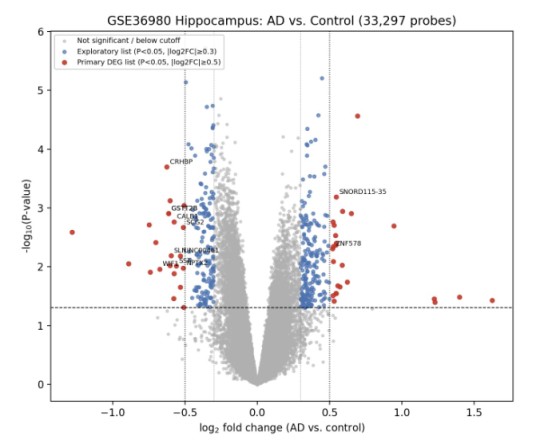
Volcano plot of all the 33,297 GSE36980 probes. The blue points represent the exploratory list while the red points represent the primary DEG list. The horizontal line represents the P = 0.05 and the vertical lines mark the fold change thresholds.
(Figure representation created by the authors: Tanush Mysore and Oliver Wulf)
Conclusion
Analysis of the GSE36980 dataset identified a hippocampal transcriptional pattern that was dominated by synaptic, neuropeptide, and inhibitory-signaling changes in AD relative to non-demented controls. Our analysis confirmed neuroactive ligand-receptor interaction, GABAergic synapse, chemical synaptic transmission, and inhibitory synapse assembly. Using the GSE1297 dataset also confirmed the results found in GSE36980, indicating similarities in AD cases. Across both datasets, the genes SST, SCG2, NPTX2, CALB1, and AQP1 showed the same directions of effect, while CRHBP showed a between-study disagreement. The meta-analysis provided support for the original synaptic/neuropeptide associated results found in the GSE36980 results while still keeping uncertainty at the individual-gene level. These results, however, are not found from a genome-wide meta-analysis due to only 6 candidate genes being synthesized. Further work could examine disease stage, cell composition, and heterogeneity across a larger amount of hippocampus samples.
By: Tanush Mysore and Oliver Wulf. The opinions expressed here are the views of the writer and do not necessarily reflect the views and opinions of Elio Academy.