Metformin as Potential Treatment for Pulmonary Fibrosis
By: Adithi Arvind

Adithi Arvind
Newbury Park High SchoolMy project focused on the AMPK pathway's role in pulmonary fibrosis. Coming to this conclusion was very exciting and through a lot of hard work. Through this, I was able to turn my thoughts into some good designs and images that can show my conclusion. Through this project I learned how to keep digging even when something does not make sense and use technology in ways I had not tried before. It made me excited and more prepared for research in the future years by simplifying the process down well enough to allow me to understand how it goes, but by also through enough to figure out things by myself.
Short Report
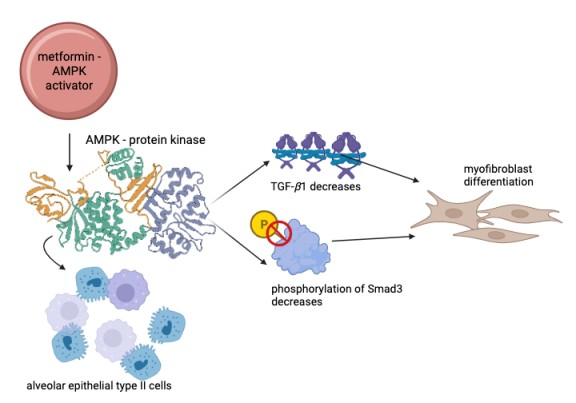
Detailed image of AMPK activation done by Metformin suppressing profibrotic signaling in alveolar epithelial cells. Metformin acts as an AMP-activated protein kinase (AMPK) activator causing inhibition of the transforming growth factor-β1 (TGF-β1) signaling and inhibits phosphorylation of Smad3. These combined effects reduce the differentiation of fibroblasts into myofibroblasts which overall helps prevent fibrosis.
(Figure representation created by the author(s): Adithi Arvind)
Background
Pulmonary Fibrosis (PF) is a subtype of ILD (interstitial lung disease) characterized by a chronic and progressive disease causing lung tissue to become thick and stiff due to the overactivation of fibroblasts in the lung tissues. This causes there to be extra cellular matrix proteins (ECM) overdeposited in the tissue surrounding the alveoli in the lungs causing lung scarring (Wilson & Wynn, 2022). Metformin is an FDA-approved drug for the treatment of type 2 diabetes. It works by blocking the liver's mitochondrial respiratory chain, which activates the adenosine monophosphate-activated protein kinase (AMPK) pathway (Rena et al., 2017). The increase of AMPK leads to the decrease in cyclic adenosine monophosphate (cAMP), which helps to downregulate glucogenic enzymes overall reducing hepatic gluconeogenesis (Zhu et al., 2023). Upregulation of the AMPK enzyme has shown to lead to the decrease in fibroblast differential into myofibroblast, which indicates a decrease in fibrosis. Relating to pulmonary fibrosis, metformin has shown to have antifibrotic effects and potentially a reversal of existing fibrosis unlike any other approved treatments for PF.
Problem Statement
PF is a fatal disease where the lungs slowly become thick due to scar tissue building up and the alveoli gets constrained leading to impeding gas exchange. Right now, there is no cure for PF and the only treatments, pirfenidone and nintedanib, can help slow down the progression of fibrosis but not help stop it or reverse any of the existence damage. This is a gap presented in treatments as patients can not gain back any lung function after being diagnosed with PF even after being on treatment. While preclinical evidence shows how the activation of the AMPK signalling pathway can help reduce fibrosis and inhibit fibroblast differentiation, possible drugs that do this in PF are not understood well. Especially the drug metformin (a well known AMPK activator) has very few studies explaining the efficacy in lung fibrosis. Addressing this gap is significant to helping come up with treatments helping patients revive their lung function and live longer.
Research Hypothesis
Pulmonary fibrosis is associated with the upregulation of the AMPK signaling pathway. The AMPK enzyme helps play a role in regulating energy in the cell and sending stress signals. So, could Metformin, being a key and well known activator of the AMPK pathway, help cure pulmonary fibrosis by reversing lung scarring and serve as a potential treatment option?
Results
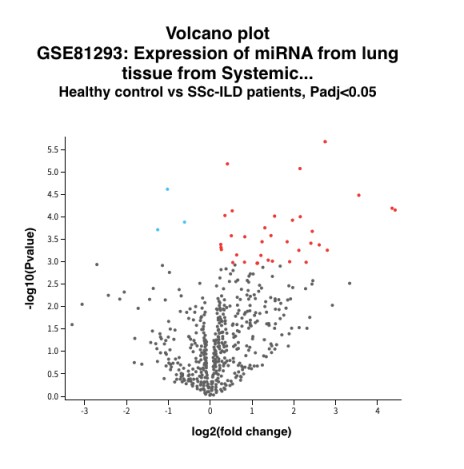
Volcano Plot of differentially expressed miRNAs between SSc-ILD patients and healthy control patients. The volcano plot shows the differential expression of miRNAs between healthy controls and patients with SSc-ILD (dataset GSE81293). The x-axis represents the log2 (fold change) in expression, and the y-axis shows the -log10 (p-value). The red dots indicate the significantly upregulated miRNAs. The blue dots indicate significantly downregulated miRNAs, and the gray dots represent non-significant changes.
(Figure representation created by the author(s): Adithi Arvind)
Differential Gene Expression Analysis: Using GEO2R to analyze SSc-ILD lung biopsy samples identified, four main up regulated miRNAs (hsa-mir-141, hsa-mir-205, hsa-mir-31, hsa-mir-182) were shortlisted for further analysis. These miRNAs regulate thousands of genes each so, to shortlist genes for analysis, only two genes were found acting on all four miRNAs (CLOCK and GMFB). These genes were excluded since they did not have a high expression in the lungs and relative presence in all other cell types so including them would not help to further analyze one pathway.
Meta-Analysis of Target Genes: Using the miRDB, target genes were identified and comparing genes from all miRNAs helped narrow down 43 genes regulated by at least three mi-RNAs. Using functional annotation clustering tools from DAVID, phosphorylation and histone protein kinase activity were involved in the function of a lot of different genes. Analyzing this further in DAVID led to the finding of the PRKAA2 gene which codes for a subunit of the AMPK enzyme. The AMPK enzyme is key for regulating the cell’s metabolism and is crucial for homeostatic processes in the cell.
Pathway Analysis (DAVID and Enrichr): Using Enrichr and DAVID, the AMPK pathway was associated with the genes the shortlisted mi-RNAs controlled significantly. Reactome analysis also showed this as phosphorylation had connected with the AMPK pathway a lot. Since the AMPK signaling pathway is related in ways to homeostasis of the cell, its connection with fibrosis activity was further investigated and multiple other studies had validated this relationship. Hence, looking into possible AMPK activity was the next step. Metformin as a significant activator for the AMPK signaling pathway was seen a lot and further investigated to see its potential impacts in lung fibrosis.
Conclusion
Metformin is a strong candidate as a treatment option for PF considering its AMPK activating functions. In pre-clinical models, metformin has shown to change the fibroblast into a nonfibrogenic phenotype and help reduce myofibroblast differentiation. This will help reduce the ECM deposition overall decreasing fibrosis. These results provide the potential for using metformin widely for multiple subtypes of ILD, considering that multiple of them include fibrosis as a factor. Further work should be done to validate these findings with larger patient data sets and human clinical studies to investigate the efficacy of metformin in human PF. Other studies focusing on connecting AMPK activation to fibroblast repro-program in the human lung tissues especially will be helpful to further validate the hypothesis. Overall, this study identifies AMPK signaling as a key regulating pathway in PF and describes Metformin as a possible treatment for fibrosis reversal in PF.
Full Report / White Paper
(Click to view the full report)
By: Adithi Arvind. The opinions expressed here are the views of the writer and do not necessarily reflect the views and opinions of Elio Academy.