Can genetic risk scores accurately predict Alzheimer’s disease before symptoms appear?
By: Adiya Kaliakparova (Binom Kanysh Satbaev (Uly Dala))
Summary
This project helps to understand about Alzheimer's disease. AD is the most common type of dementia, affecting more than 55 million people worldwide. It typically grows silently several decades before any memory loss develops. While age is a key risk factor, genetics play an important role when choosing who gets the disease and when symptoms appear. The current study addresses whether genetic risk scores, specifically Polygenic Risk Scores (PRS) and Polygenic Hazard Scores (PHS), can accurately predict Alzheimer's disease before symptoms show. These scores are based on known genetic variations in genes such APOE epsilon4, Amyloid Precursor Protein (APP), Presenilin 1 & 2 (PSEN1 & PSEN2), CLU, BIN1, PICALM, CR1, and TREM2.
PRS analyzes a person's overall genetic risk, while PHS examines age timing, predicting when symptoms could develop. Both scores use balanced genetic variants to calculate a z-score. High scores have been linked to biological changes such as increased amyloid beta plaques, hippocampus weakness, and early memory loss, which happen years before diagnosis.This study compares a normal brain and a brain with Alzheimer's disease, with particular attention to the accumulation of harmful amyloid, overactive immune cells called astrocytes, and higher levels of inflammatory chemicals such as IL-1b, IL-6, TNF-α, and ROS.Alzheimer's disease advances progressively over decades, making early diagnosis necessary. Genetic models, such as PRS and PHS with composite z-scores that include APOE and other risk genes, provide an acceptable method for early risk analysis. This work emphasizes the importance of combining genetic data with brain imaging and biomarker research to better understand and predict Alzheimer's disease before symptoms appear. Para 2
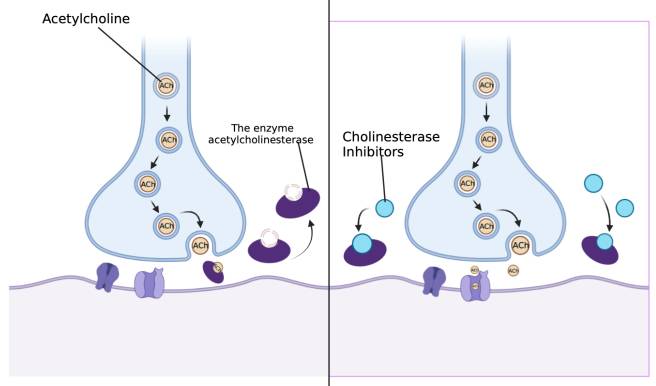
Cholinesterase inhibitors (donepezil and rivastigmine): Working scheme
(Figure representation created by the author: Adiya Kaliakparova)
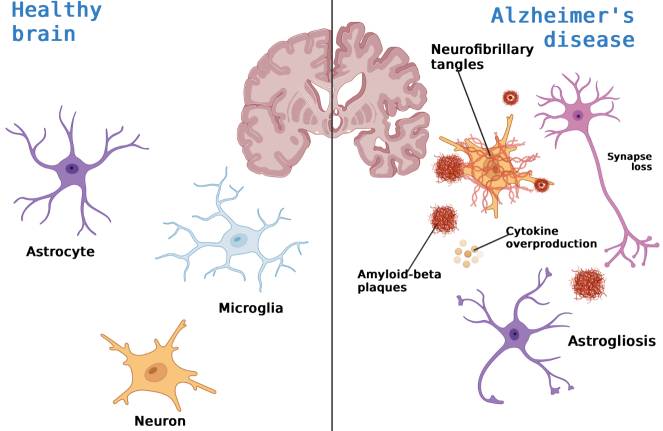
Normal Brain vs Alzheimer's Brain Molecular Comparison
(Figure representation created by the author: Adiya Kaliakparova)
Video Presentation
Impact Statement

Adiya Kaliakparova
Hi, my name is Adiya and I attend Binom Kanysh Satbaev School, Astana, Kazakhstan. I've always liked biology, but wanted to expand my interest in it, which is why I decided to take ELIO Academy courses. Before taking this course, I didn't realized how powerful genetics and data analysis could help to predict and understand diseases like Alzheimer's disease. Right now I see how using data from multiple genes, such as APOE, CLU, and TREM2, can help determine a person's risk to disease even before symptoms appear. It made me think on how science is more than simply data, that it is about people's lives, early detection, and prevention. What had the most impact on me was learning how to read actual scientific papers, other scientists work and use them accurately on my own, applying that knowledge to create something meaningful - a poster and presentation I could be truly proud of. I used to be afraid by advanced biological terminology, but now I know how to analyze and explain them to others. This course improved my confidence significantly. I'm not just memorizing, I'm understanding. And it has inspired me to explore more study in the future, starting from now.
Student Reflection
By: Adiya Kaliakparova. The opinions expressed here are the views of the writer and do not necessarily reflect the views and opinions of Elio Academy.