Inhibition of Dual-Specificity Phosphatase 1/6 (DUSP1/6) as a Combination Therapy for Spinal Muscular Atrophy
By: Jacob Shachar and Raj Datta

Jacob Shachar
Washington Township High SchoolWorking with Elio Academy of Biomedical Sciences has given me many things: what doing research entails, deep knowledge about biology and cellular mechanics, and plenty of new friends. Going into this program, I was hoping to gain experience doing real research; I have always wanted to sit down and learn as much about something as I can for the sake of learning, and research seemed like the best way to do that. And let's just say, it did not disappoint; the ERP program taught me how to build foundational knowledge on a topic, extend that further into asking meaningful questions, form a hypothesis, collect and analyze data, use various tools to draw conclusions, and search for solutions.

Raj Datta
Paramus High SchoolAttending ELIO Academy's ERP, I learnt to conduct professional research. My instructor taught me about a multitude of bioinformatic tools to turn my topical knowledge into substantive figures. I learned how to format and write official, publishable papers, as well as how the entire process works. We had several lessons that walked us through the groundwork of bioinformatics, building our specific topic knowledge on top of it. My research skills were refined, as normal note-taking skills were transferred and adapted for biomedical research. The ERP program has greatly prepared me for the future, as it has taught me the foundational research principles from which all of my future research will stem. Finally, ELIO helped me build teamwork and networking skills.
Short Report
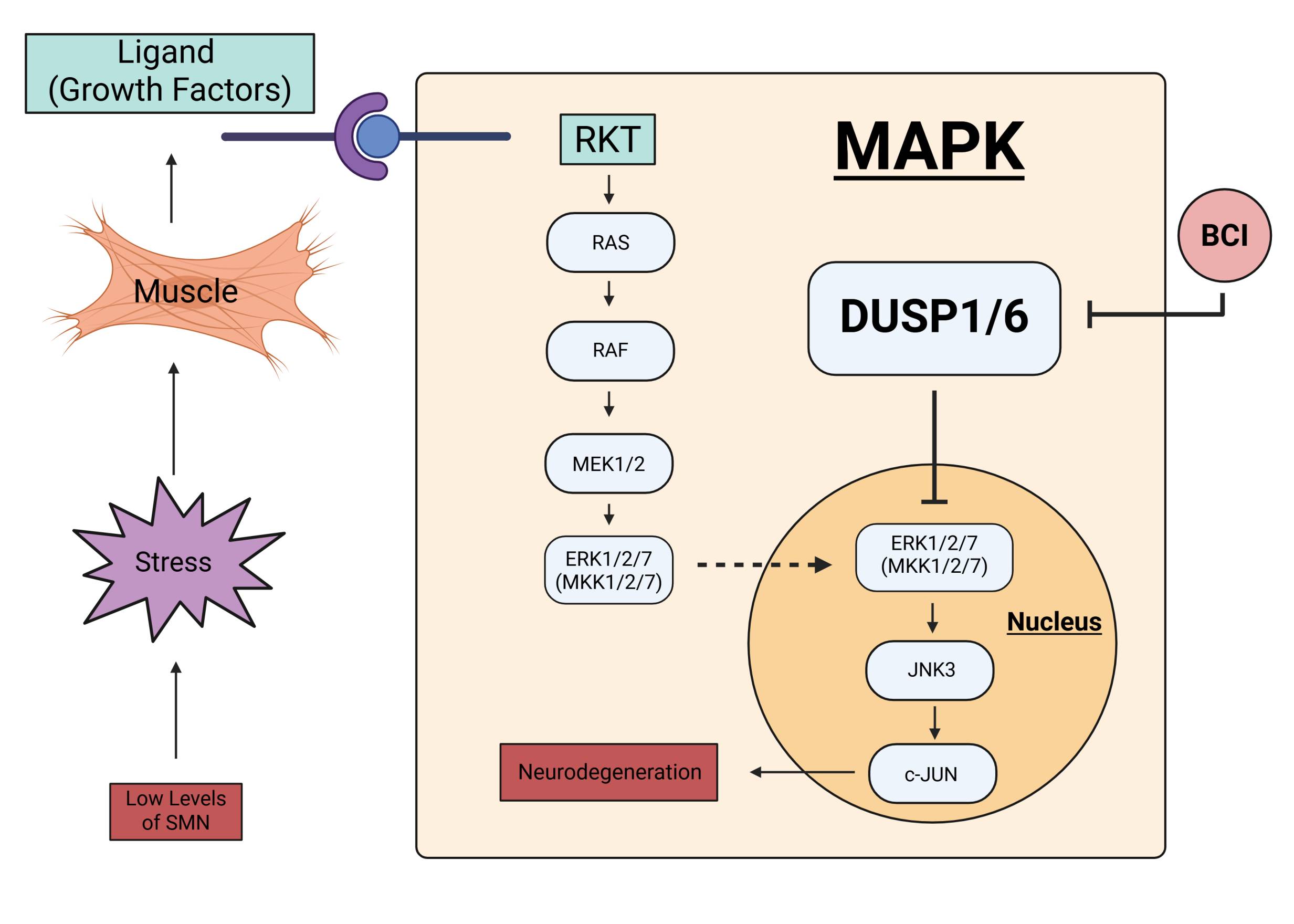
Schematic representation of the relevant MAPK cascade and BCI inhibition of DUSP1/6. Stress from low levels of SMN causes certain ligands to activate in the presence of growth factors, triggering the ERK1/2/7 cascade. DUSP1/6 inhibit ERK1/2–regulating JNK3 and c-JUN–promoting apoptosis and neurodegeneration. Additionally, DUSP1/6 also tends to inactivate pro-survival cascades, like certain p38 MAPK pathway branches and ERK1/2/7. The upregulation of DUSP1/6 altogether promotes apoptosis, as expressed in SMA. BCI is an allosteric inhibitor of DUSP1/6, which can prevent some of the effects of SMA caused by the overexpression of DUSP. Normal arrows describe a direct stimulation, flat arrows indicate direct inhibition, and dotted arrows represent translocation. JNK3: c-Jun N-terminal kinase 3.
(Figure representation created by the authors: Jacob Shachar and Raj Datta)
Background
Spinal Muscular Atrophy (SMA) is a genetically inherited neurodegenerative disorder caused by a mutation of the Survival Motor Neuron 1 (SMN1) gene. SMN1 codes for the Survival of Motor Neuron (SMN) protein. SMN is responsible for cytoskeleton development–allowing for the extension of neurites–and pre-mRNA splicing. There exists a paralogous copy of SMN1 called SMN2, which transcribes misfolded SMN 90% of the time. Gene editing of a single nucleotide in exon 7 of SMN2 has been shown to eliminate the misfolded proteins, transforming SMN2 into a functional copy of SMN1. However, this has only been done in vivo on mice, and only ex vivo experiments have been done on human stem cells. In both experiments, the results were very promising.
Problem Statement
Spinal Muscular Atrophy (SMA) is a neurodegenerative disease caused by a mutation of the Survival Motor Neuron 1 (SMN1) gene. In all subtypes of SMA, SMA0/1/2/3/4, symptoms remain congruent: respiratory failure, muscle weakness, instability, loss of motor/survival controls, scoliosis, weakened nervous system, and loss of strength. The clinical symptoms appear to mainly derive from the function of the SMN1 gene. SMN1 plays a key role in pre-mRNA splicing and cytoskeletal development. This deficiency in SMN1 leads to inhibition of neurite development, severing the motor neuron's connection to the muscle and leading to atrophy. In addition, DUSP1/6 are present in all significant patients from our clinical dataset. DUSP1/6 is responsible for inhibiting the regulator of apoptosis and cell proliferation in the MAPK pathway. Since DUSP1/6 is upregulated in SMA, other stress factors induce apoptosis.
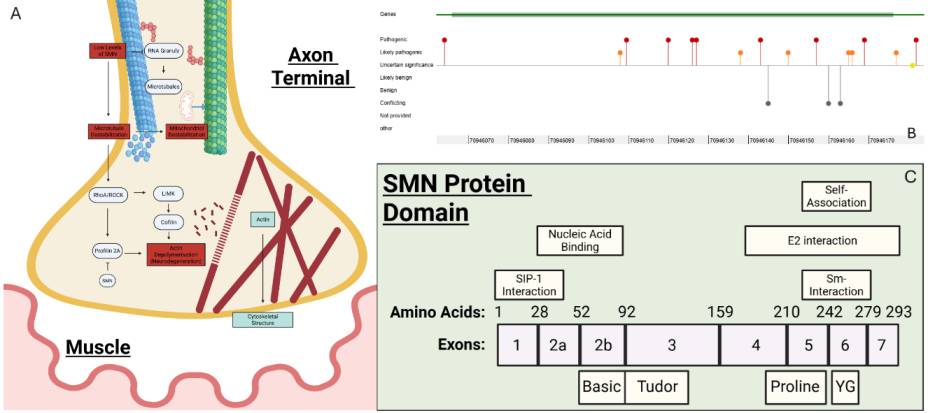
Schematic representations of the effects of downregulated SMN1. [A] The model explores the effect of low levels of SMN in an axon terminal at a neuromuscular junction. With less SMN, mitochondrial destabilization and actin depolymerization occur. This results in a weak cytoskeleton that is unable to support the axon, severing the neuromuscular junction. [B] The graph exhibits the clinically validated mutations identified genes in SMN1. The region corresponds to only exon 7 of SMN1, which is known to have mutations in SMA. The different lines indicate various severities: red is pathogenic, orange is likely pathogenic, yellow means uncertain significance, and grey is conflicting. These colors are symbolic of the severity of each mutation found on SMN (ClinVar). [C] The amino acid sequence for SMN in relation to its function(s). The various significant protein domain. RhoA/ROCK: Ras homolog family member A, and LIMK stands for LIM-kinase.
(Figure representation created by the author(s): Jacob Shachar and Raj Datta)
Research Hypothesis
If we use BCI to inhibit Dual-Specificity Phosphatase 1/6 (DUSP1/6), then we can mitigate several effects of SMA when combined with SMA gene therapy because DUSP1/6 inhibit regulatory proteins in the Mitogen-activated protein kinase (MAPK) signaling pathway. This MAPK pathway is responsible for cell differentiation, cell proliferation, and apoptosis; controlling cell growth or death. Since DUSP1/6 is an inhibitor to the protein responsible for decision-making, it causes uncontrolled apoptosis. To limit this undesired apoptosis, DUSP1/6 need to be inhibited–through the use of BCI–to less unneeded apoptosis and more regulatory proteins.
Results
We have identified dual-specificity phosphatases 1 and 6 (DUSP1/6) as significant proteins in our patient data set. In every one of our functional clusters, DUSP1/6 were present as relevant genes. Upon further investigation, these proteins appear to play a big role in cell differentiation, cell proliferation, and apoptosis. In SMA, it appears that overexpression of DUSP1/6 causes apoptosis, as DUSP1/6 inhibiting differentiating processes causes other stress factors, such as those caused by low levels of SMN, to induce apoptosis. We decided to look into inhibitors for DUSP1/6, which led us to discover BCI, an allosteric inhibitor of the two proteins. We propose the use of this BCI in combination with gene therapy as a treatment for SMA.
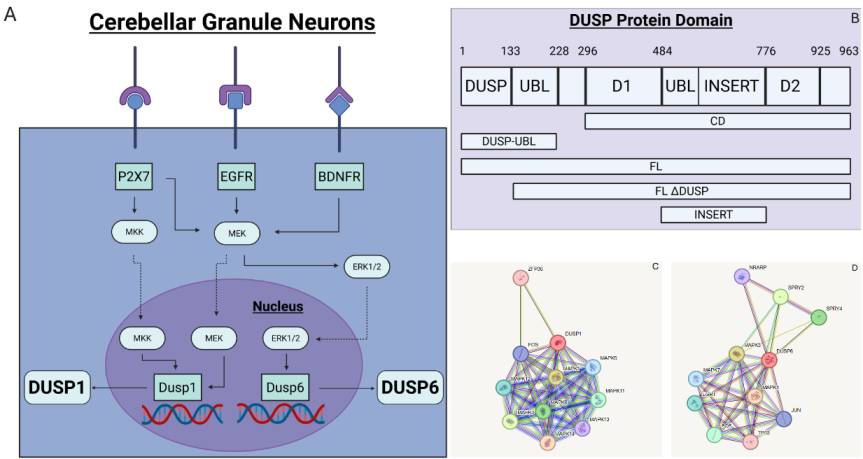
Schematic representing the mechanisms, protein domain, and other interacting proteins for DUSP1/6. [A] Signaling cascade of DUSP1/6 and its upregulation. [B] A diagram showing the DUSP protein domains. Each bar is a specific functional domain of the DUSP proteins. The numbers above the bars represent the corresponding amino acid number. [C, D] A representation of proteins that interact with DUSP1/6. Lines between proteins represent different functional links between two proteins/genes (STRING). Solid arrows represent a direct stimulatory relationship, and dotted arrows indicate a translocation. EGFR: Epidermal Growth Factor ReceptorS. BDNFR: Brain-Derived Neurotrophic Factor Receptors.
Conclusion
SMA patients produce faulty SMN proteins due to mutations in the SMN1 genes. The lack of SMN causes neuronal degeneration leading to many other clinical issues: respiratory failure, muscle weakness, instability, loss of motor/survival controls, abnormal body structure (scoliosis), weakened nervous system, and loss of strength. SMN2 gene editing is promising, but it has some flaws; it stops the production of faulty SMN, but it does not correct the major symptoms caused by the previous lack of production of SMN – it takes time for muscles to regrow and for motor neurons to re-proliferate. Since it takes the therapy time to take effect, during this time DUSP1/6 have ample time to cause too much apoptosis. This leads to major unnecessary cell death, hence, we propose the use of BCI as a combination therapy: to aid in keeping the cell alive long enough for the neurons and muscles to be healthy again from the increased SMN production.
By: Jacob Shachar and Raj Datta. The opinions expressed here are the views of the writer and do not necessarily reflect the views and opinions of Elio Academy.