Treatment of Alzheimer's Disease of Seniors Living Alone
By: Jaeyeon Bae (Harbin Wanbang School)
Summary
This work aims to present combinations of treatments that is applicable to elderly people who have Alzheimer’s disease (AD). Alzheimer’s disease is a brain disorder. When a person gets Alzheimer’s disease, the function of their brain decreases slowly. As elderly population increases, the number of people who have dementia, mainly caused by Alzheimer’s disease, is annually increasing. Although there are other causes of Alzheimer’s disease, ageing is the major cause of it; therefore, it is important to pay attention to the AD of seniors.
Treatments for AD can be classified into two: pharmacological and psychological. There are two types among pharmacological treatments: drugs that relieve symptoms and Disease-Modifying Treatments, DMTs. Drugs that relieve symptoms can again be classified into two: drugs for cognitive symptoms and drugs for non-cognitive symptoms. For cognitive symptoms treatments, there are Cholinesterase Inhibitors and NMDA antagonist. For non-cognitive symptoms treatments, there are orexin receptor antagonist and atypical antipsychotics. Among DMTs, Lecanemab and Domanemab are most widely used. There are mainly two psychological treatments: cognitive stimulation therapy (CST) and cognitive behavioral therapy (CBT). Compare and contrast are done by three standards: safety, effectiveness, and sustainability. All of the treatments that are introduced were analyzed by all of the standards, except the psychological treatments. Psychological treatments are analyzed by one standard, which is effectiveness. It is because psychological treatments barely have risk and long-term side-effect.
As the result, NMDA antagonist and Lacanemab were the safest treatments for AD. Moreover, for elderly people, developing non-pharmacological treatments is the priority. Therefore, combination of both pharmacological and psychological treatments should be implied to the treatment of AD for elderly people. The two combinations that are suggested are NMDA antagonist + CST/CBT and Lacanemab + CST/CBT.
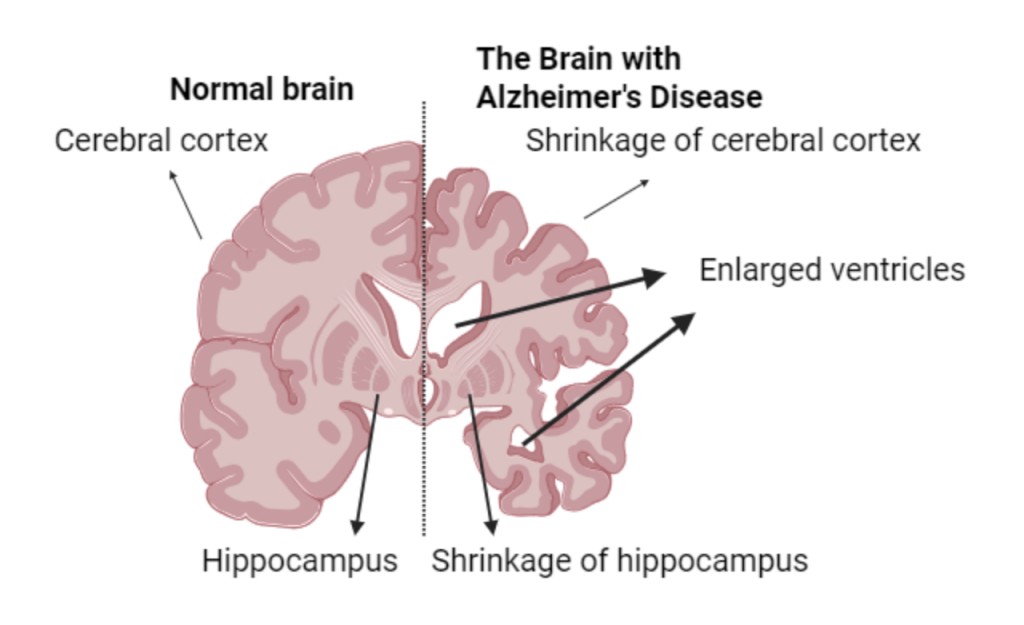
Comparison between healthy and Alzheimer's brain
(Figure representation created by the author: Jaeyeon Bae)
Impact Statement

Jaeyeon Bae
For me, neuroscience was a totally new area. At first, I was a bit afraid about it because the majority I could think about neuroscience was a bunch of hard and long jargons. However, this great opportunity helped me to change my perspective towards this field completely. I learned that brain is the most enigmatic organ of our body, or perhaps, the most enigmatic object in the universe. I was able to understand thoroughly about brain though I knew merely nothing before. Moreover, through researching, I learned that, to generate a good research result, I should plan ahead. By planning before I research, I could find more and accurate information, and I was able to save my time. Additionally, this opportunity of making a research poster helped me to be prepared for future research that it helped me to develop perseverance. My poster was about Alzheimer’s disease and its treatments that there were numerous amounts of information I had to find. It was a lot of work; however, I persisted. Therefore, I was able to finish the poster with comparably complete information. In the future, I am sure that I will do harder research; so, I determined to not give up though in hard circumstances. I am grateful that I could challenge myself and learn valuable lessons throughout the whole two weeks of program.
Student Reflection
By: Jaeyeon Bae. The opinions expressed here are the views of the writer and do not necessarily reflect the views and opinions of Elio Academy.