Role of Upregulated Cathepsin-H (CTSH), Heat Shock Proteins (HSPs) in C9orf72 Mutated ALS
By: Kylie-Bibhuti Chalise

Kylie-Bibhuti Chalise
Jericho High SchoolThrough this program, I improved my skills as a researcher and student. Apart from learning more about my research topic, I also learned more about various topics like molecular biology, neuroscience, cancer biology, etc. The program also strengthened my analysis and interpretation skills. The program has challenged me as a researcher, helping me work with limitations and problem-solving. Overall, my experience has been amazing. I would recommend the program to those with a strong passion and interest for research.
Short Report
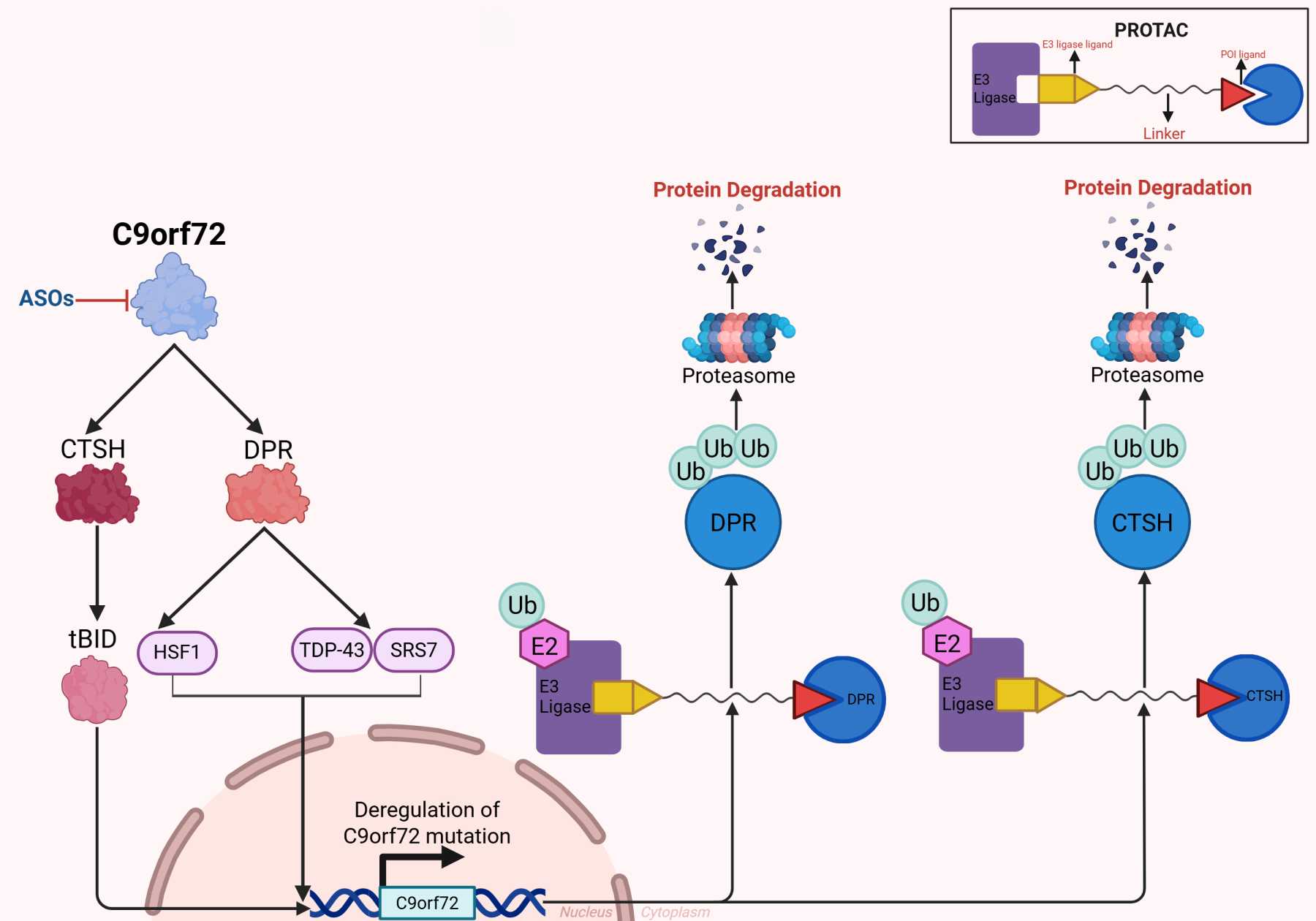
Schematic representation of the PROTAC model. The PROTAC tags the protein with the E3 ligase with ubiquitin to degrade the target protein; the proteasome recognizes the tag and breaks aggregated proteins further.
(Figure representation created by the author: Kylie-Bibhuti Chalise)
Background
According to NIH, Amyotrophic Lateral Sclerosis (ALS) is projected to globally increase by almost 70% by 2040. ALS is a progressive neurodegenerative disease affecting nerve cells in the brain and spinal cord, leading to muscle atrophy, motor neuron deterioration, and apoptosis. The average lifespan of ALS patients ranges from 2 to 5 years, with delayed diagnoses because most ALS symptoms are unnoticed. Risk factors consist of advancing age, gender, familial history of ALS, head trauma, and exposure to environmental toxins (Andrew et al., 2020). As of now, the exact cause of ALS remains unknown. However, research has suggested that 61% of sporadic and 10% of familial ALS cases are influenced by genetic factors such as mutations (Al-Chalabi et al., 2010). The most common identified mutation in ALS is C9orf72, accounting for 40% of familial cases. C9orf72-mutation is formed by a repeat expansion of hexanucleotide sequence, G4C2, where n greater than 30. This project looked into upregulated proteins in C9orf72 ALS, and PROTAC as a potential threaputic target.
Problem Statement
According to research studies, ALS cases are expected to rise significantly by 2030. As the cause of ALS is unknown and still being investigated, it becomes difficult to develop a therapeutic target. This project focused specifically on C9orf72-mutated ALS. This mutation is highly prevalent in ALS patients. This mutation leads to a buildup of toxic misfolded proteins, harming other pathways and proteins crucial for neuronal regulation. In C9orf72-mutated ALS, CTSH was upregulated. Increasing the expression of Bcl-2 homologous proteins, including the pro-apoptotic protein BID and the anti-apoptotic proteins BCL2 and BCL2L1. Although BCL2 and BCL2L1 are promoted, BID prevents the protective effect of both proteins. BID then proceeds to activate BAX and BAK, proapoptotic proteins of BCL2, forming pores in the outer mitochondrial membrane leading to Cytochrome c’s release, and Bcl-xS, a proapoptotic protein of BCL2L1, which antagonizes BCL-xL, blocking cell survival. This aggregates apoptosis.
Research Hypothesis
Role of upregulated CTSH in causing C9orf72-mutated ALS, the role of Hsps, molecular chaperones in ALS, and how molecular chaperones can be aided with PROTAC implementation. Overall, the project focuses on investigating toxic upregulated proteins in C9orf72-mutated ALS, assessing the efficacy of Hsps in preventing protein aggregation and improving neurodegeneration, and confirming PROTAC as a potential therapeutic target of upregulated CTSH and DPRs, regulating the function of Hsps.
Results
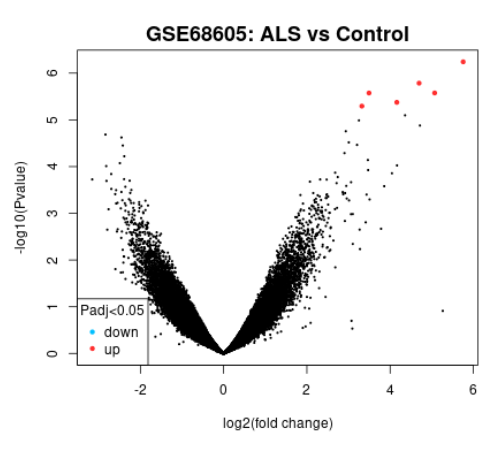
Schematic representation of significant DEGs with a logFC greater than 2 within GSE68605 accession. Upregulated proteins are highlighted in red.
As of now, the exact cause of ALS remains unknown. However, about 70% of familial ALS cases involve genetic mutations. C9orf72 mutation results in the production of Cathepsin-H (CTSH) and toxic dipeptide repeat proteins (DPRs), downregulating the C9orf72 gene, therefore aggregating neuronal dysfunction and inflammation. DPRs increase heat shock factors such as HSF1, crucial for molecular chaperone production, a potential therapeutic target for ALS treatment, as it aids cells in treating misfolded proteins. However, molecular chaperones aggregate DPR toxicity by enhancing its solubility and resistance to degradation. Additionally, DPR toxicity depletes RNA-binding proteins (RBPs), such as TDP-43, by disrupting the cells’ transport pathways and mislocating TDP-43, leading to its aggregation.
DPR toxicity also reduces SRSF7 expression, downregulating essential proteins like STMN, which repairs motor neurons. Furthermore, upregulation of CTSH increases expression of Bcl-2 homologous proteins, including pro-apoptotic protein BID and anti-apoptotic proteins BCL2 and BCL2L1. Although BCL2 and BCL2L1 are promoted, BID prevents the protective effect of both proteins. BID then proceeds to activate BAX and BAK, proapoptotic proteins of BCL2, forming pores in the outer mitochondrial membrane leading to Cytochrome c’s release, and Bcl-xS, a proapoptotic protein of BCL2L1, which antagonizes BCL-xL, blocking cell survival. As CTSH and DPRs aggregate, chronic ER stress is accumulated, activating caspases, which are protease apoptotic inhibitors.
Caspase 8 converts BID into its active form, tBID. tBID releases cytochrome c, which binds to apoptotic protease-activating factor 1 (Apaf-1), forming an apoptosome that binds to procapase-9, changing the shape to activate it to Capase-9. Caspase-9 cleaves procaspase-3 to activate. Caspase-3, which executes apoptosis. This process aggravates motor neuron degeneration, regressing the progression of ALS. Therefore, protein aggregation and apoptosis serve as hallmarks of ALS. Thus, it’s crucial to develop potential therapeutic treatments for ALS that target aggregated proteins and apoptosis.
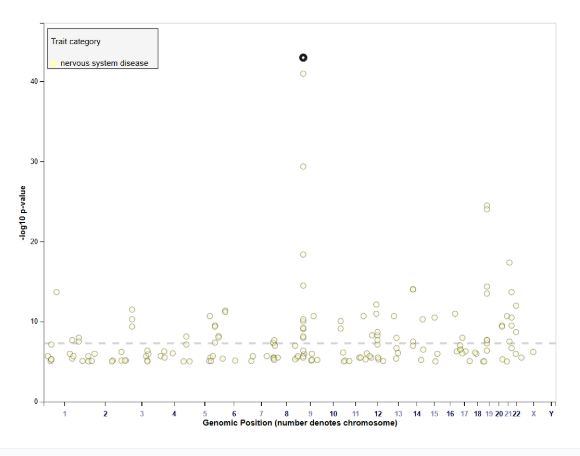
Schematic representation of the C9orf72 gene (black shaded dot) located on chromosome 9, showing its high prevalence in ALS.
Conclusion
Analyzing the studies, C9orf72 was found to be an upregulated mapped gene. GSE68605 accession discovered that C9orf72 expansion of the GGGGCC repeat is a common genetic variant correlated with ALS, producing splicing dysregulation and disrupting the RNA’s splicing process. DEGs with a logFC ≥ 2 and p less than 0.05 were considered statistically significant. Clusters with high enrichment scores were analyzed. Disulfide bond showed upregulation of Cathepsin-H (CTSH). After identifying upregulation of genes, the associations and networks with other proteins were analyzed using StringDB. Analyzing the identified WikiPathway (WP2447) for ALS, BID, BCL2, and BCL2L1 were concluded as upregulated genes. DPRs also increase heat shock factors such as HSF1, crucial for molecular chaperone production, a potential therapeutic target for ALS treatment, as they aid cells in treating misfolded proteins. However, molecular chaperones aggregate DPR toxicity by enhancing its solubility and resistance to degradation. To inhibit protein aggregation, this design implements molecular chaperones into the PROTACs to target C9orf72-mutated ALS. This not only targets toxic upregulated proteins but also aids in supporting molecular chaperones’ activity as the C9orf72 mutation interacts with heat shock proteins (HSPs), particularly HSP70 and HSP90, straining the molecular chaperones.
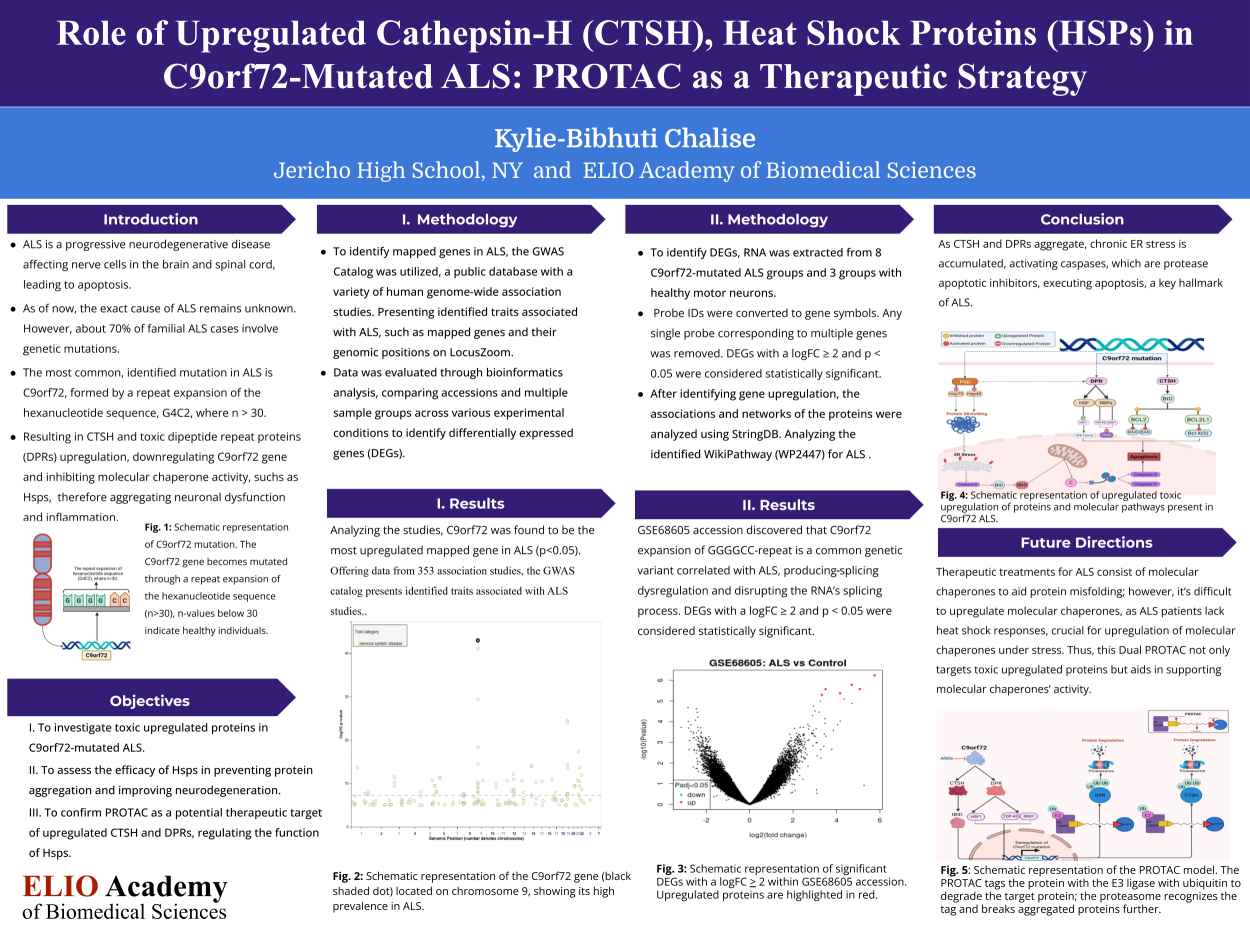
By: Kylie-Bibhuti Chalise. The opinions expressed here are the views of the writer and do not necessarily reflect the views and opinions of Elio Academy.