Targeting the Ubiquitin-Proteosome System to Reduce Mitochondrial Stress in MELAS
By: Niti Singh and Siri Srivatsa

Niti Singh
Great Valley High SchoolI learned advanced content about gene therapies and the process of research. This improved by skills as a researcher because it allowed me to explore how to research and gave me the foundational tools towards success in future projects.
Short Report
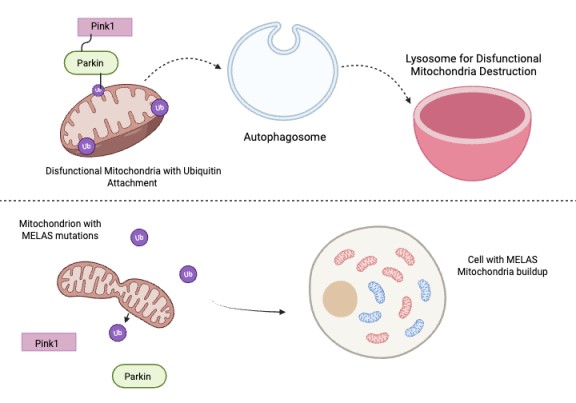
(Figure representation created by the authors:Niti Singh and Siri Srivatsa)
Background
MELAS is a rare mitochondrial disorder typically caused by the m.3243A G mutation in mitochondrial DNA. This mutation disrupts oxidative phosphorylation, leading to reduced ATP generation, lactic acid buildup, and high levels of ROS (reactive oxygen species). Moreover, because of their high energy demand, the brain and muscle are highly vulnerable due to this condition, causing seizures, muscle weakness, and recurrent stroke-like episodes. Recent studies have signaled the importance of mitophagy and the ubiquitin-proteasome system (UPS) in MELAS. Normally, these pathways clear damaged mitochondria and prevent excess ROS. In MELAS, impaired or overwhelmed mitophagy worsens mitochondrial dysfunction. Enhancing UPS-mediated mitophagy and using antioxidants to reduce oxidative stress have shown significant potential to restore mitochondrial balance, making them promising therapeutic directions.
Problem Statement
MELAS syndrome is a mitochondrial disorder with limited treatment options; the disease is driven by mutations in mtDNA that impair mitochondrial energy production, leading to oxidative stress, cellular damage, and progressive neurological decline. Although the UPS (ubiquitin-proteasome system) and mitophagy are critical for removing damaged mitochondria, their functions in MELAS has not been explored widely. Current therapies – such as antioxidants – provide only partial symptom relief and do not address the underlying mitochondrial dysfunction. This highlights the urges need to explore how enhancing UPS-mediated mitophagy can definitely reduce mitochondrial damage.
Research Hypothesis
In MELAS syndrome, impaired or insufficient activity of the ubiquitin-proteasome system contributes to the accumulation of dysfunctional mitochondria. Enhancing ubiquitin-mediated mitophagy may reduce mitochondrial stress and improve cellular function.
Results
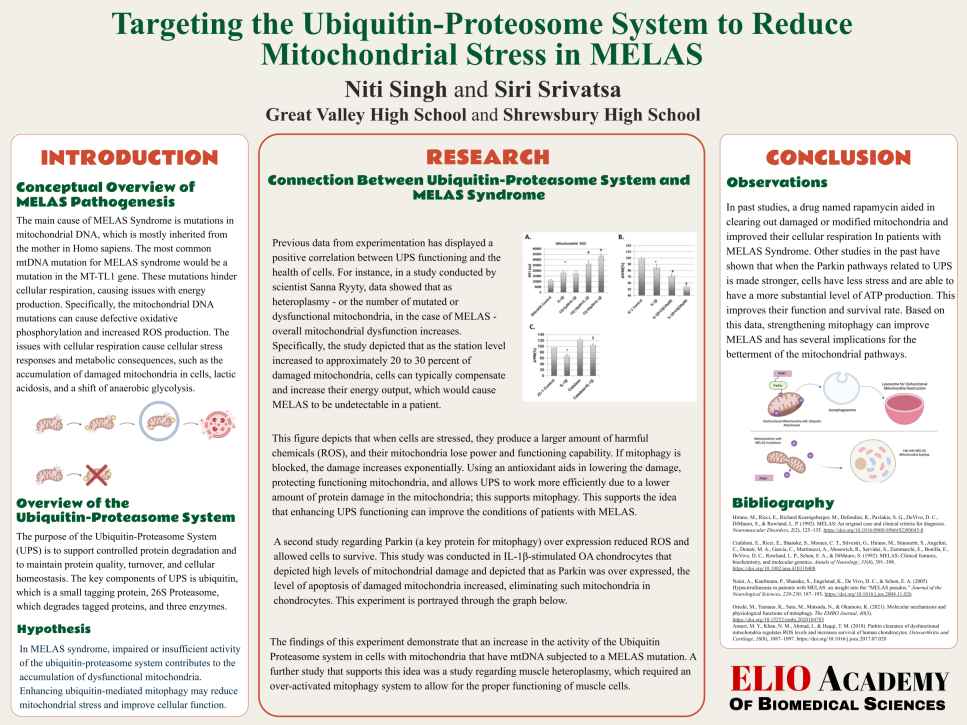
The findings of the research study indicate a clear relationship between UPS activity, mitophagy, and mitochondrial health in MELAS. The data demonstrates that as heteroplasmy increases, overall mitochondrial dysfunction worsens. Previous experiments explored for this study reveal that at moderate levels, cells can compensate for lower ATP levels by boosting energy production, making MELAS largely undetectable. However, at higher heteroplasmy levels, mitochondrial function sharply declined, leading to reduced ATP output and greater cellular stress. Stress conditions were also associated with ROS production, and when mitophagy was lessened, mitochondrial damage escalated exponentially. By contrast, another treatment with antioxidants lowered ROS, preserved healthy mitochondria, and allowed UPS to function more efficiently in removing protein-damaged mitochondria. Experiments studying Parkin overexpression demonstrated a similar concept, showing that cells with enhanced Parkin activity demonstrated reduced ROS, higher rates of mitophagy success, and increased survival. Additionally, rapamycin treatment improved mitochondrial clearance and cellular respiration in MELAS models. Therefore, these results support the hypothesis that enhancing UPS-mediated mitophagy, especially alongside antioxidant treatment, can protect mitochondrial function, increase ATP production, and improve cellular survival in MELAS conditions.
Conclusion
This research project explores the role of the UPS system’s activity in mitigating mitochondrial dysfunction in MELAS. MELAS is caused primarily by the m.3243A G mutation, which impairs oxidative phosphorylation, reduces ATP production, and increases reaction oxygen species, or ROS. The results show that cells with moderate heteroplasmy can compensate for mitochondrial defects, while higher heteroplasmy leads to severe dysfunction and elevated ROS. Blocking mitophagy worsens damage, whereas enhancing UPS activity, overexpressing Parkin, and administering antioxidants protects mitochondria, reduces ROS, and improves cellular survival treatment. Overall, the findings suggest that strengthening UPS-mediated mitophagy, combined with antioxidant support, can enhance mitochondrial quality control, restore ATP production, and improve cell viability.
By: Niti Singh and Siri Srivatsa. The opinions expressed here are the views of the writer and do not necessarily reflect the views and opinions of Elio Academy.