CRISPR/Cas9 Editing in Acute Myeloid Leukemia
By: Prisha Virmani
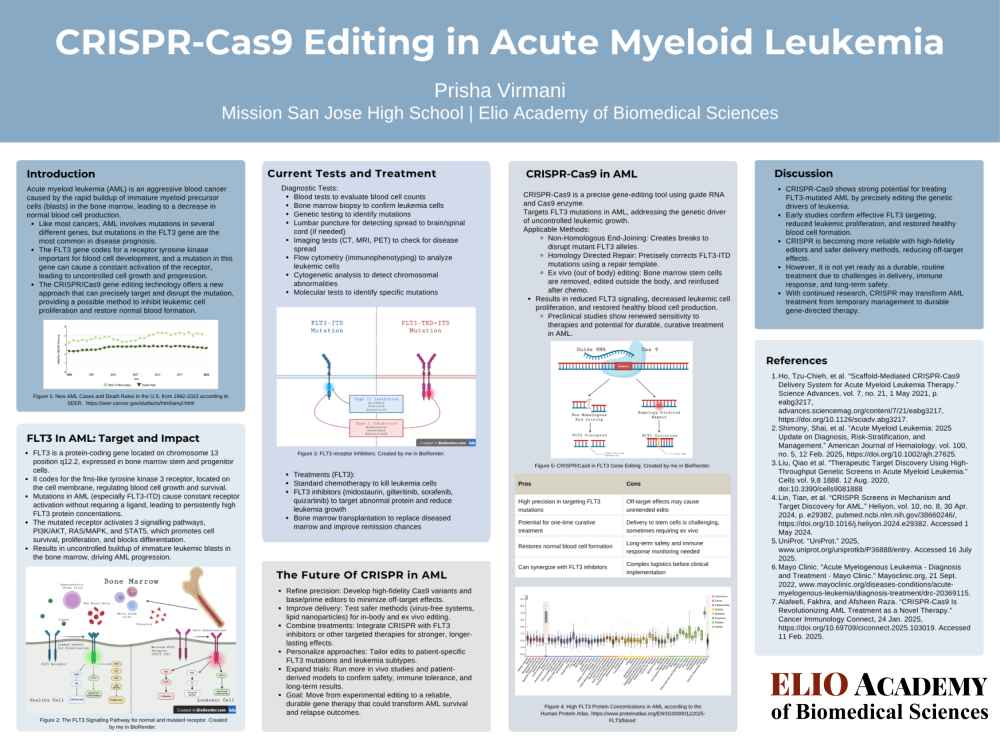
Summary
This project explores the potential of CRISPR-Cas 9 gene editing in Acute Myeloid Leukemia (AML), a highly aggressive blood cancer characterized by the rapid accumulation of immature myeloid cells. Among the several different gene mutations in AML, FLT3 is the most prevalent and leads to the continuous activation of the FLT3 signaling pathway. This results in consistently high levels of the FLT3 protein, driving cell proliferation, inhibiting cell differentiation, and worsening disease progression. Current treatments (example: chemotherapy, FLT3 inhibitors, and stem transplants) continue to face issues of resistance and relapse, emphasizing the need for more durable approaches.
CRISPR-Cas9 is a precise tool that can directly target and disrupt the FLT3 mutation at the DNA level. It uses guide RNAs to direct the Cas9 nuclease to the faulty gene in the DNA and can edit it in two different ways. The first is Non-Homologous End Joining (NHEJ) which creates breaks to disrupt the mutant alleles and the second is Homology-Directed Repair (HDR) which disrupts the allele and replaces it with a repair template from donor DNA. This can be performed in-vivo (inside the body) or ex-vivo (outside the body) by editing the patient’s bone marrow stem cells and reinfusing them after the patient undergoes chemotherapy. Studies show that CRISPR can reduce unnecessary FLT3 signaling, lower cell proliferation, and eventually restore hematopoietic cell function in AML models.
Although the technology is promising some challenges remain, including delivering the Cas9 nuclease to the mutated cell, minimizing off-target effects, and ensuring safety in the long run. Future directions include the development of high-fidelity Cas9 variants, exploring prime-editing, and possibly combining CRISPR with current therapies to enhance treatment outcomes. CRISPR-Cas9 could transform AML treatment from short-term care to accurate gene correction, offering promise for a long-term, personalized approach to fight this aggressive cancer.
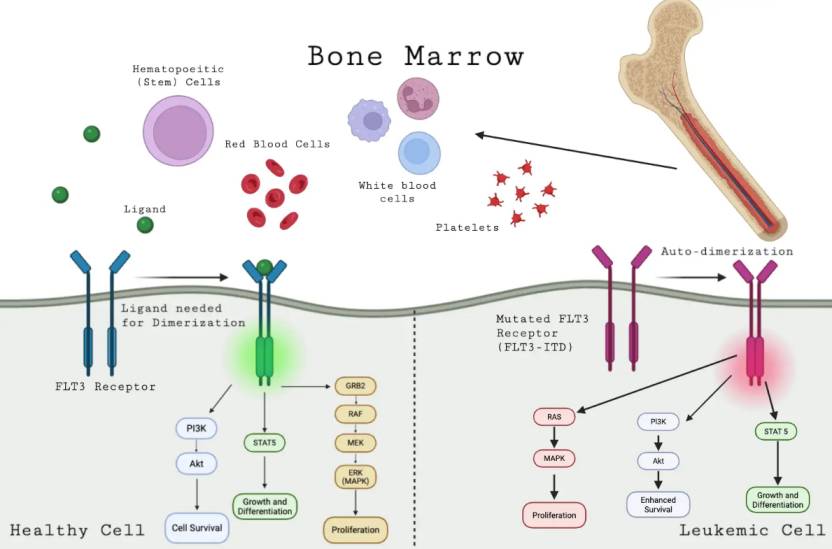
The FLT3 Signalling Pathway for normal and mutated receptor.
(Figure representation created by the author: Prisha Virmani)
Video Presentation
Impact Statement
Prisha Virmani
Hi! My name is Prisha Virmani and I am a senior at Mission San Jose High School. As a biology enthusiast, Elio became the perfect opportunity to dive deep into biomedical sciences. I chose the genetics course because of my passion for genomics and cancer biology, making the course a perfect fit to expand my understanding and research skills. Going into my first class I knew what I wanted to explore: CRISPR. For my project, I researched Acute Myeloid Leukemia (AML) and the potential of CRISPR-Cas9 as a treatment. AML is an aggressive blood cancer with limited treatments, and I explored how precise gene editing could offer hope to patients. For my research, I analyzed how the FLT3 mutation plays a role in AML. Using resources like NCBI and Uniprot, I investigated the possibilities and challenges of applying CRISPR clinically. Through this program, I learned how to read and analyze scientific studies, extract key information, and communicate complex ideas clearly through my poster. My two-week experience with Elio transformed the way I view genetics and deepened my commitment to pursue genomics in college to innovate treatments that can one day cure diseases like AML.
Student Reflection
By: Prisha Virmani. The opinions expressed here are the views of the writer and do not necessarily reflect the views and opinions of Elio Academy.