Understanding Parkinson’s Disease: Genetic Factors and Emerging Treatments
By: Samaira Kapoor (Manav Rachna International School)
Summary
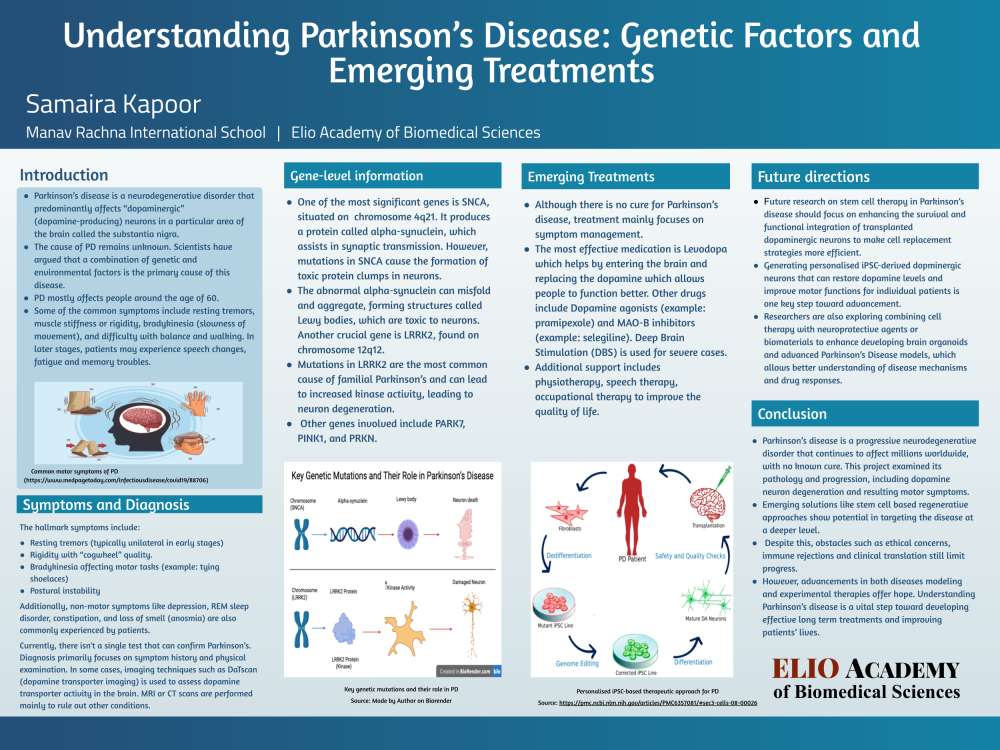
This project explores Parkinson's disease, its genetic factors, and emerging treatments. PD is a neurodegenerative disorder that predominantly affects the dopaminergic neurons in the substantia nigra of the brain. This condition most commonly affects people around the age of 60, but in some cases individuals can experience it before turning 50. Some of the common symptoms include resting tremors, muscle stiffness or rigidity, bradykinesia (slowness of movement), and difficulty with balance and walking. This study highlights various diagnosis techniques like symptom history, physical examination, DaTscan (dopamine transporter imaging), and MRI or CT scans.
Treatments such as using medications like levodopa and MAO-B inhibitors, and, in severe cases, deep brain stimulation (DBS) techniques are also explored. Furthermore, the MPTP mouse model is analyzed to better understand the disease. Lastly, future research on stem cell therapy in Parkinson’s disease and other research, such as the one conducted in 2018 for PD and their role in developing effective long-term treatments and improving patients’ lives, is also inspected.
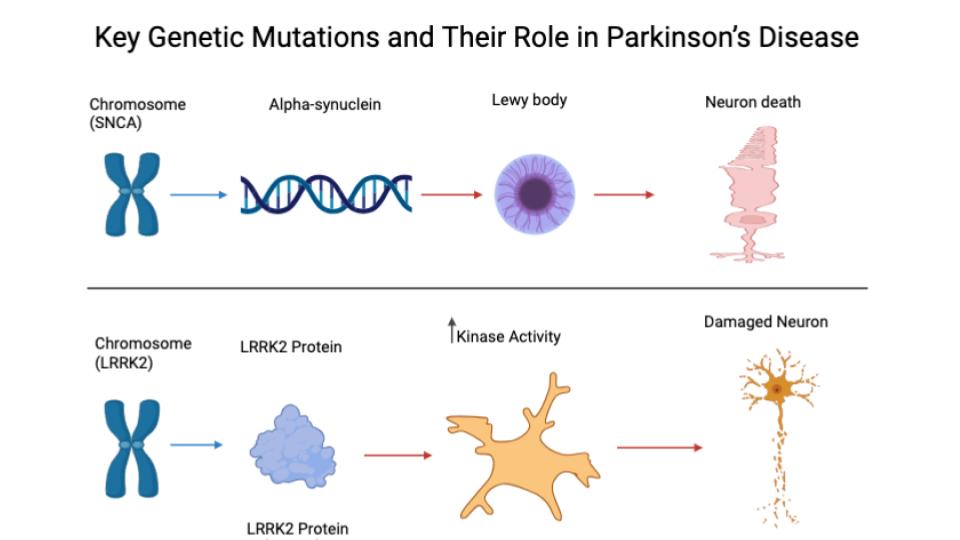
Key genetic mutations and their role in PD
(Figure representation created by the author: Samaira Kapoor)
Video Presentation
Impact Statement

Samaira Kapoor
This project was based on understanding Parkinson's disease, its genetic factors, and emerging treatments. I learned how genetic mutations like SNCA produce a protein called alpha-synuclein, which assists with synaptic transmission—the process of sending signals between neurons in the brain—and can lead to the formation of toxic protein clumps in neurons. This lesson helped me understand that the abnormal alpha-synuclein can misfold and aggregate, forming structures called Lewy bodies, which are toxic to neurons. I am becoming more familiar with neurodegeneration and genetic mutation. I gained experience on how to analyze complex topics using the literature review method, research posters, and database exploration, which in turn improved my ability to review scientific literature, identify reliable resources, and draw conclusions from data. I gained many useful skills, such as scientific writing, poster designing, and presenting complex ideas simply. I understood how to think critically about connecting information across systems and synthesizing genetics and neurology. Now, I feel confident about pursuing a career in medical science. This opportunity has increased my interest in the field of biotechnology and has equipped me with tools to approach scientific research with confidence and clarity.
Student Reflection
By: Samaira Kapoor. The opinions expressed here are the views of the writer and do not necessarily reflect the views and opinions of Elio Academy.