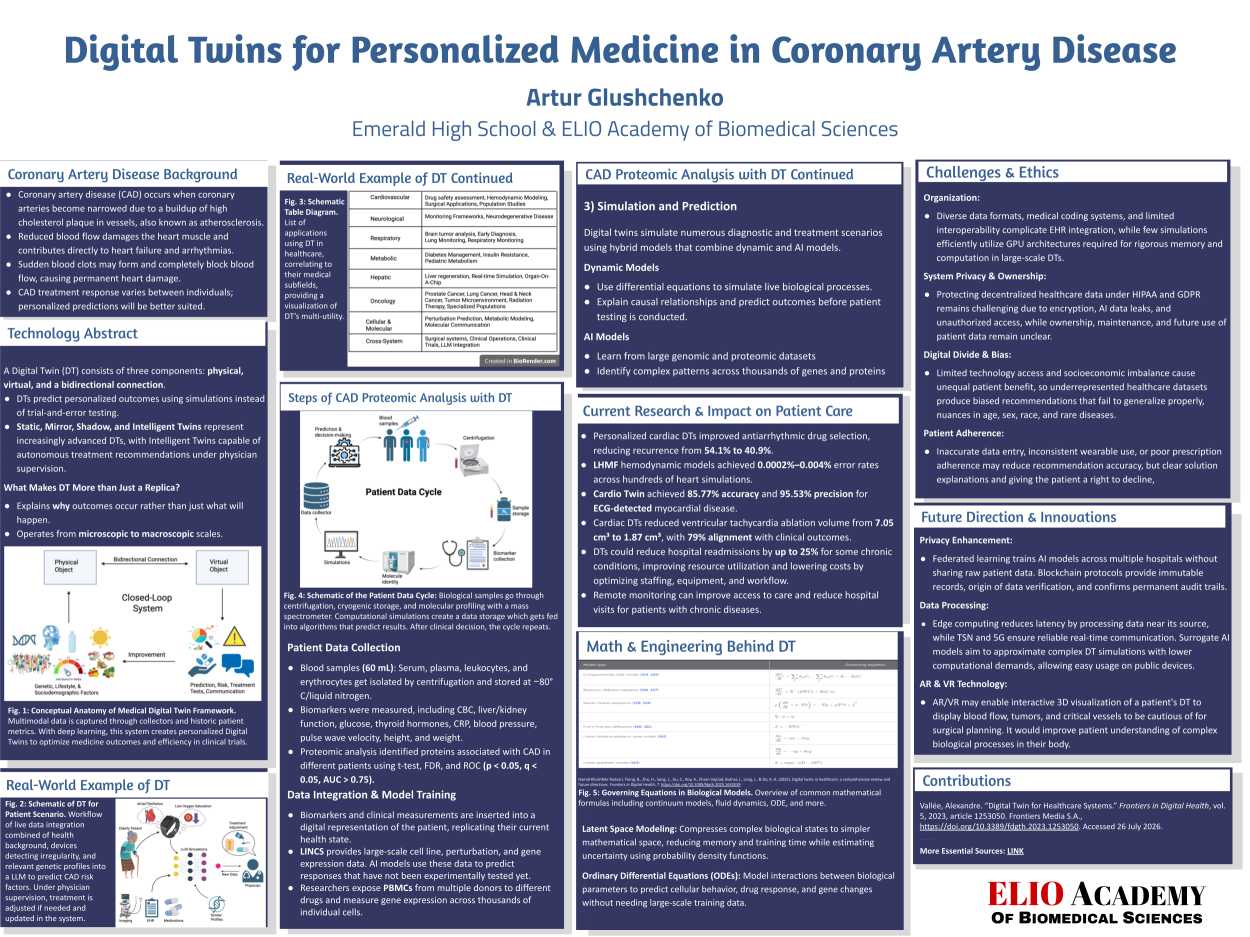
Digital Twins for Personalized Medicine in Coronary Artery Disease.
By: Artur Glushchenko (Emerald High School)
Summary
Coronary artery disease (CAD) is one of the most significant issues in cardiovascular health today. It occurs when blood flow gets slowed down or completely blocked due to a buildup of cholesterol plaque on the vessel edges, called atherosclerosis. Recently, technologies such as Digital Twins are beginning to generate personalized predictions for each individual patient instead of trial-and-error testing with generalized approaches.
Digital Twins is an evolving topic that combines medicine, biology, mathematics, and AI technology into one bidirectional system. Large Language Models (LLMs) integrate patient blood sample components, medication, imaging scans, biomarkers and genetic information, along with lifestyle, socioeconomic, and physiological factors. Consequently, simulations are run to determine and explain specific drug selection, metabolic pathways, and ultimately gene expression to achieve the best CAD disease prevention with minimal side effects. The physician evaluates the data and makes the ultimate decision of what treatment to prescribe the patient. There are many models that play their part in this systemic approach, including dynamic models and AI models. Dynamic models focus on running biological simulations and help visualize outcomes by using differential equations and fluid dynamics to detect molecular change over time. AI models require an extensive amount of data training in proteomics, epigenomics, and transcriptomics to indicate accurate predictions.
The impact on patient care is already incredible, from improvements in antiarrhythmic drug selection, to extremely accurate hemodynamic models, to reduced hospital readmission rates, especially for patients with chronic diseases. However, many factors still remain a challenge, such as data interoperability, system privacy and ownership, digital divide, bias, patient adherence, and transparency. Despite that, the future of digital twins is bright due to new security implementations, data processing innovations, and potentially even AR/VR technologies. These enhancements would ensure that patient data is tamper-resistant, treatment verification is still available in emergency response environments, and patients truly understand biological complexities in their body instead of simply trusting a professional’s words. The multi-utility of Digital Twins is endless inside and outside of healthcare as a whole due to the success and future outlook in its respective methodologies and thus, specific solutions that prioritize safety, security, optimization, and understanding.
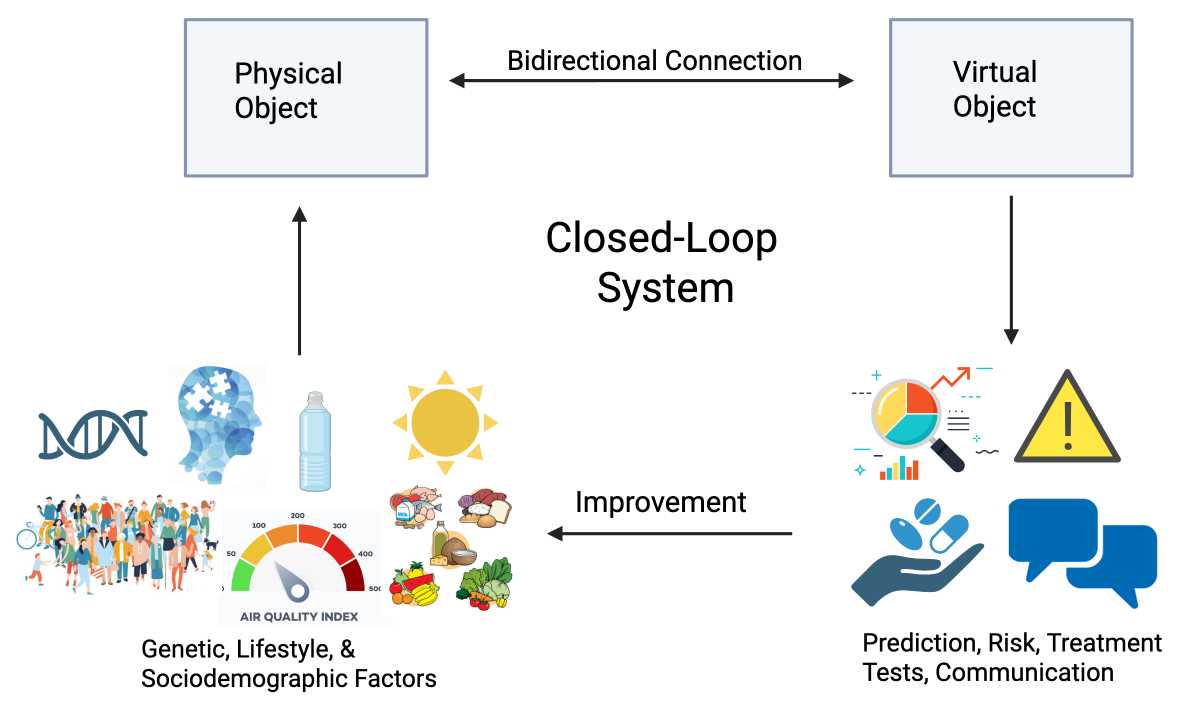
Conceptual Anatomy of Medical Digital Twin Framework. Multimodal data is captured through collectors and historic patient metrics. With deep learning, this system creates personalized Digital Twins to optimize medicine outcomes and efficiency in clinical trial.
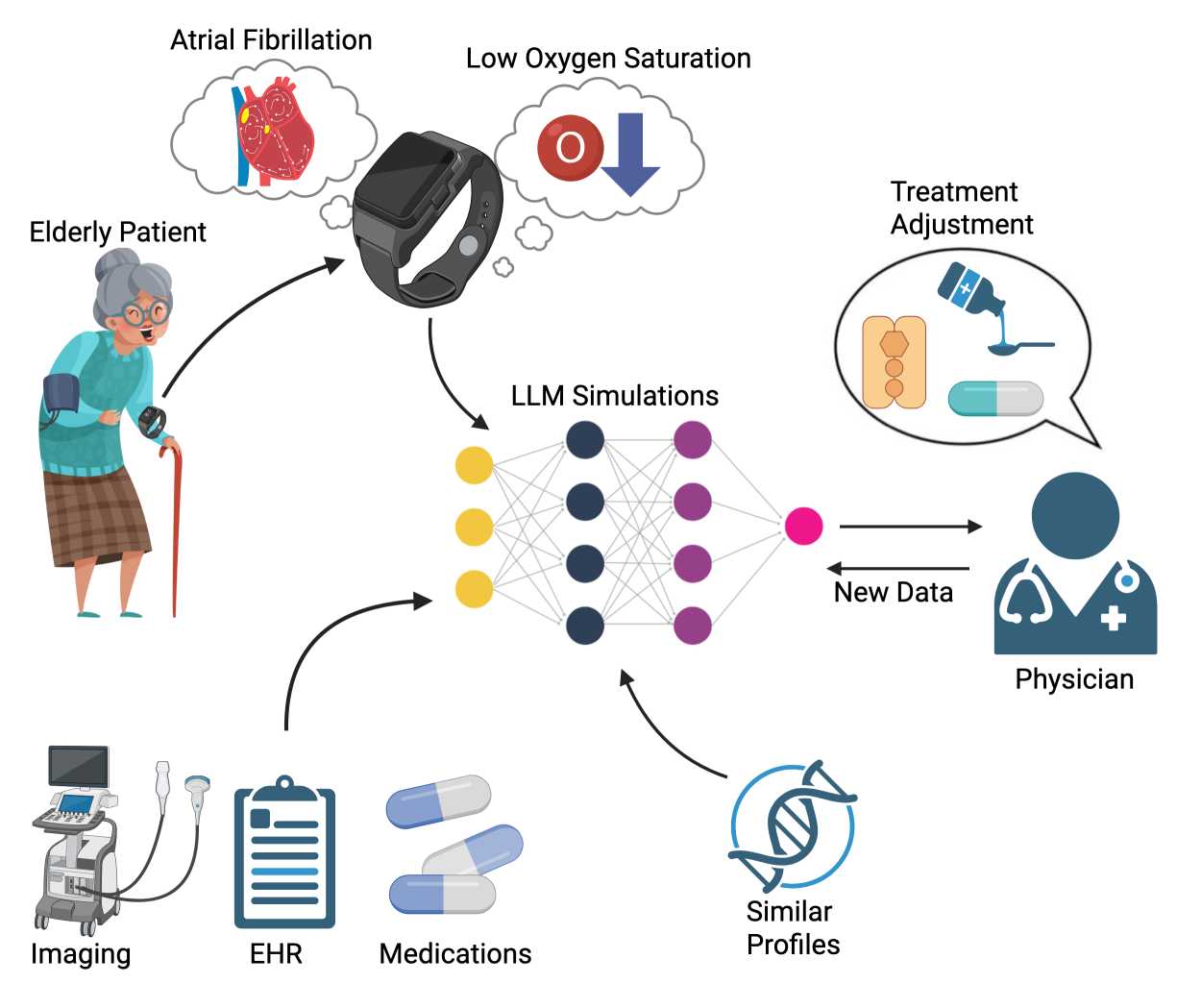
Schematic of DT for Patient Scenario. Workflow of live data integration combined of health background, devices detecting irregularity, and relevant genetic profiles into a LLM to predict CAD risk factors. Under physician supervision, treatment is adjusted if needed and updated in the system.
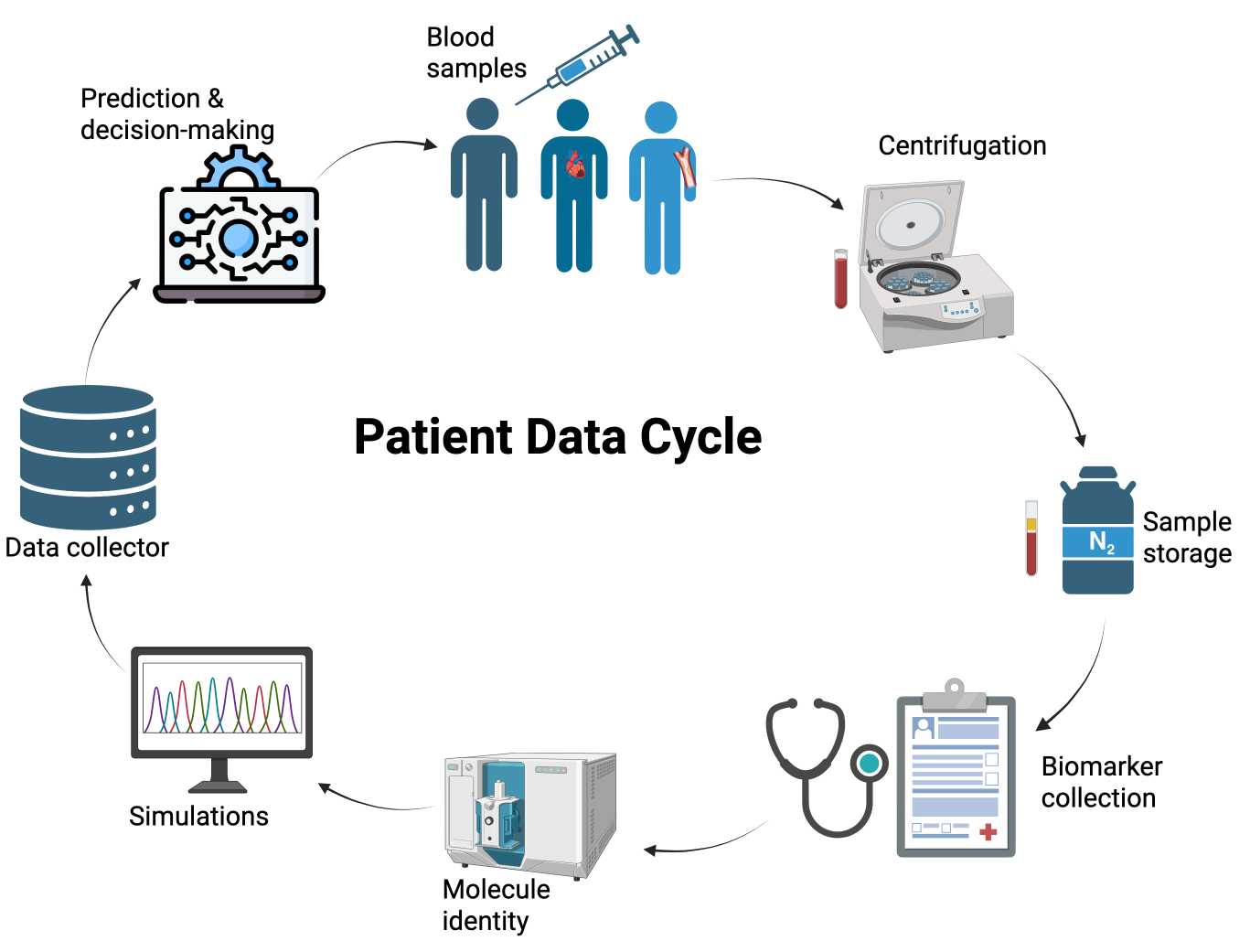
Schematic of the Patient Data Cycle: Biological samples go through centrifugation, cryogenic storage, and molecular profiling with a mass spectrometer. Computational simulations create a data storage which feeds into algorithms that predict results. After clinical decision, the cycle repeats.
Video Presentation
Impact Statement
Artur Glushchenko
From this program, I deepened my understanding in numerous topics such as cancer and data science, but also specific characteristics of different proteins, genes, drug functions, and DNA. I expanded my knowledge in mutations and diseases, and how that impacts the operation of patient care in the past, present, and future. I also learned how to develop and present a professional research poster, from technical details of text and image organization, to how to find niche reliable sources and extract information in an orderly process. This academy improved my skills of identifying cause-and-relationship, evaluating the content and quality of resources, and learning how to think in the mindset of a researcher that can use various tools to impact healthcare development. For future research, I am now more prepared to take on uprising and advanced research programs because of my extended knowledge of biological processes. Additionally, I now have more acknowledgment for the discipline and dedication that is required to complete these projects that could impact my future career.
Student Reflection
By: Artur Glushchenko.