Artificial Intelligence in Radiomics for Early Lung Cancer Detection
By: Katherine Tse (George Washington High School)
Summary
Lung cancer is often diagnosed at a late stage, when treatment is less effective, and survival rates are lower. Current lung cancer screening using low-dose CT has reduced lung cancer deaths, but CT interpretation can be difficult and time-consuming. Radiologists may miss small lung nodules or produce false positive results, which can lead to unnecessary follow-up. This project focuses on Artificial Intelligence (AI) in Radiomics for Early Lung Cancer Detection as a biomedical technology that can improve the accuracy and efficiency of lung cancer screening. The project examines how AI is improving early lung cancer detection in radiomics and its advantages and limitations compared to conventional CT scan interpretation. Deep Learning, especially Convolutional Neural Networks (CNNs), can learn patterns from large amounts of CT scan data and recognize abnormalities without requiring manual extraction.
AI-based lung cancer detection follows several steps. A patient first receives a CT scan, which is entered into an AI system trained using previous lung scan images. The AI identifies and segments the lungs, analyzes the images, and looks for patterns such as suspicious lung nodules. It can detect and classify nodules, predict cancer risk and growth, and identify suspicious findings. The AI generated results are then reviewed by a radiologist, who makes the final clinical decision and determines follow-up care. AI can also support other areas of biomedical research, including disease diagnosis, biomarker discovery, drug development, personalized treatment, and patient monitoring. By analyzing large and complex data sets, AI can support clinical decision-making and help healthcare professionals identify important patterns.
Although AI has several potential benefits, including earlier and more accurate detection, faster analysis, improved clinical decision-making, and better prediction of treatment response and patient outcomes, challenges remain. AI systems require large, high-quality, and diverse datasets, and concerns include data privacy, security, bias, explainability, accountability, ethical issues, regulatory approval, cost, and accessibility. AI is designed to assist rather than replace radiologists. Overall, AI can improve lung cancer screening and support earlier diagnosis while advancing biomedical research through the analysis of imaging, genomic, and clinical data. Continuous clinical validation, diverse training datasets, and responsible implementation are needed before widespread clinical use.
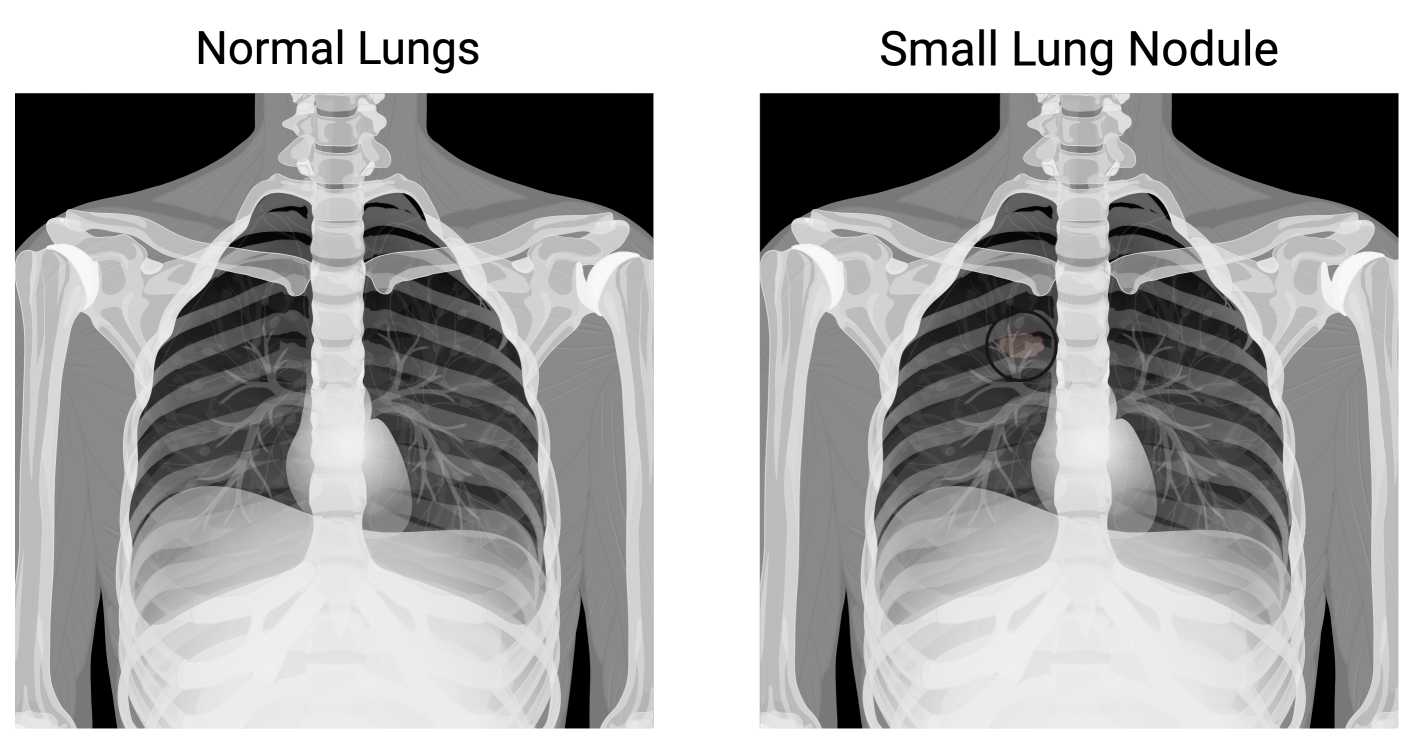
Comparison of a normal lung and a lung with a small nodule
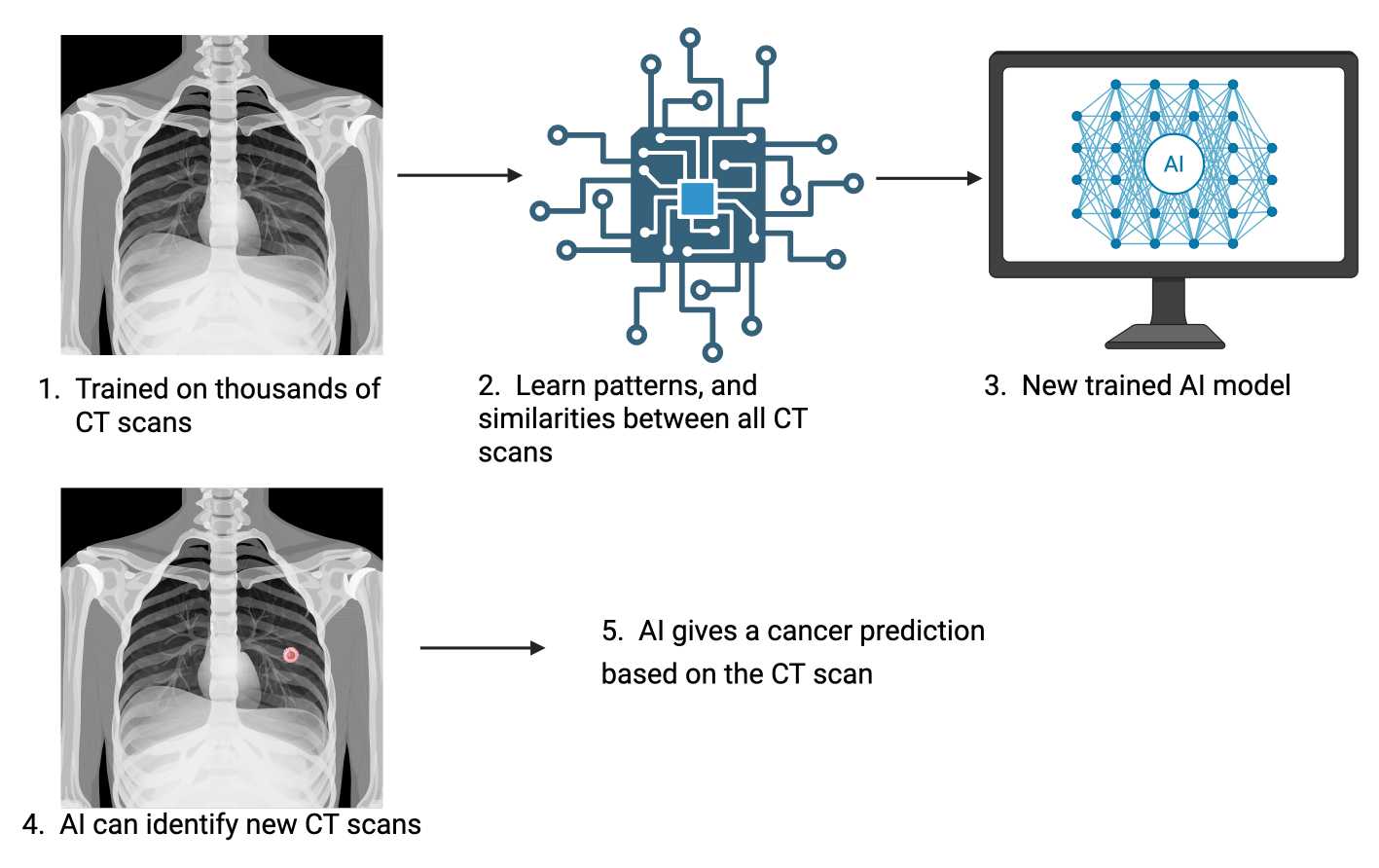
How AI learns to detect lung cancer from CT scans
Video Presentation
Impact Statement

Katherine Tse
Through this capstone project, I gained a deeper understanding of how artificial intelligence (AI) is transforming healthcare, particularly in the early detection of lung cancer. I learned how deep learning models, such as convolutional neural networks (CNNs), analyze low-dose CT scans to detect lung nodules, improve diagnostic accuracy, reduce false positives, and support radiologists in making more informed clinical decisions. I also explored the advantages, limitations, and ethical concerns of implementing AI in clinical practice, including data privacy and the need for continued clinical validation. This project improved my research, critical thinking, and communication skills. I learned how to read scientific papers, compare AI-based diagnosis with traditional CT scan interpretation, and understand evidence from biomedical studies. It also helped me explain complex biomedical technologies more clearly and in a more organized way. Overall, this experience prepared me for future research by improving my understanding of clinical decision-making, new biomedical technologies, and how AI can support precision medicine, improve early lung cancer detection, and lead to better patient outcomes.
Student Reflection
By: Katherine Tse.