Should a Child’s Brain Be Treated Like an Adults Brain in Concussions?
By: Ketan Manek (Oaks Christian High School)
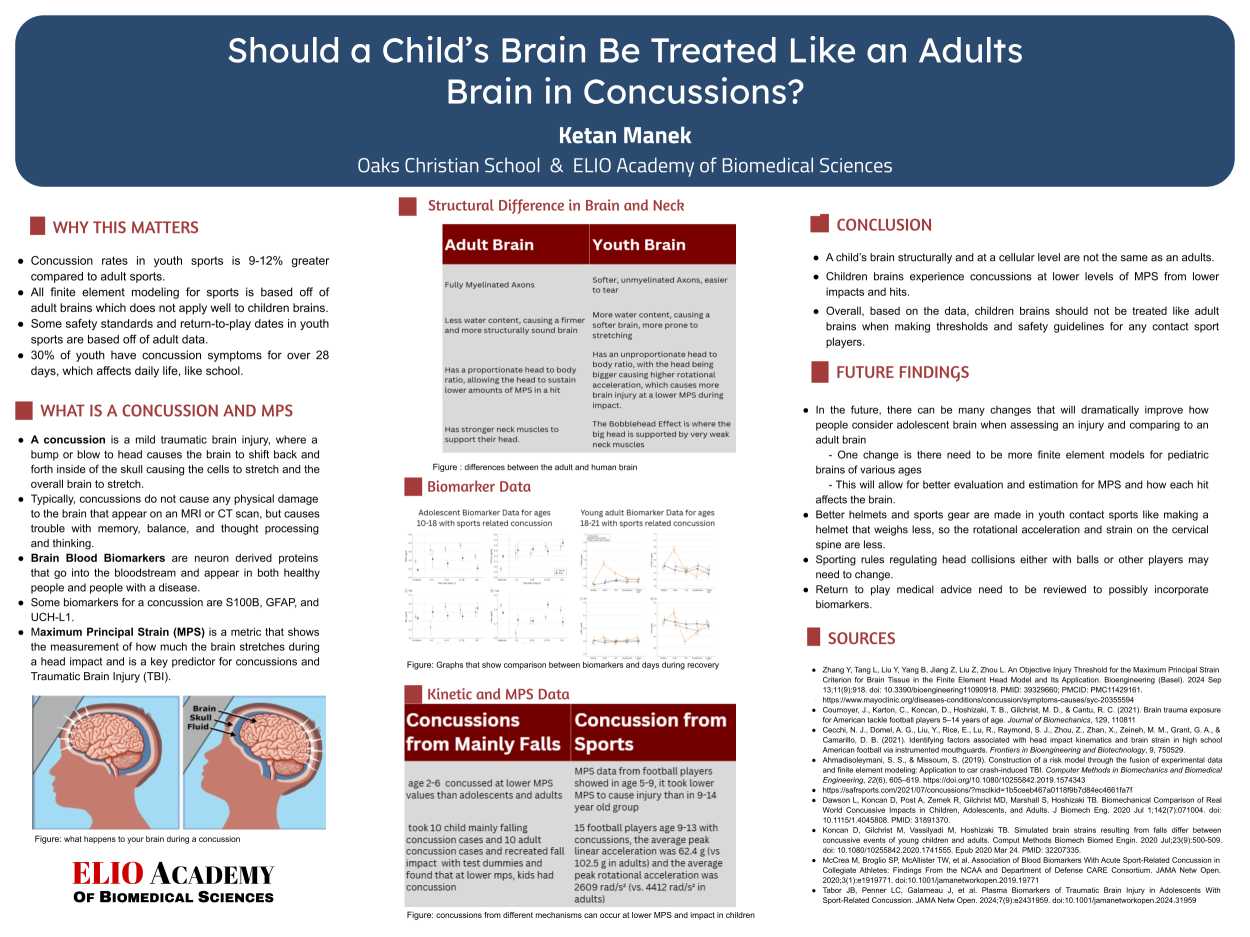
Summary
This project is analyzing whether a child's brain should be treated the same as an adult's brain when assessing a concussion. Concussions are mild traumatic brain injuries triggered by an impact or blow that forces the brain to shift rapidly inside the skull, stretching cells and disrupting normal function. Concussions do not show any physical damage to the brain that show up on fMRI or CT scans, making it hard to analyze whether someone has a concussion. Scientists analyze biomarkers like UCH-L1, S100B, and GFAP to determine whether someone has a concussion or not. Mechanically, researchers quantify the actual physical strain on brain using a metric called Maximum Principal Strain (MPS), which measures internal tissue stretching via computer modeling of impact data.
A core focus of the paper is the structural vulnerability and disadvantage of developing brains. Adult brains contain fully myelinated, well-protected axons, lower water content for increased structural firmness, and a proportional head-to-body ratio. On the other hand, children possess softer, unmyelinated axons that stretch and tear easily, alongside a higher water content that lowers structural resistance. Furthermore, children exhibit a disproportionately large head size compared to their bodies. If you pair a large head with weak neck muscles, get something called the Bobblehead Effect during impacts, which generates higher rotational acceleration and severe strain on the developing brain and cervical spine.
Concussion data from falls and sports shows that kids ages 2-6, experience concussions at lower levels of impact and MPS. At the molecular level, data tracking adolescents (median age 16) and young adults (median age 19) displays age-specific biomarker behaviors after a sports-related concussion. For instance, post-injury tau protein levels initially decrease in adolescents but spike in young adults. Biomarker timelines show that adolescent brains take much longer to recover, with certain injury markers failing to return to baseline levels even 28 days after the impact. This indicates that a child's brain may still suffer from ongoing injury even if they say they are ok.
My project concludes that adult brains impact thresholds and return dates should not be applied to children. Additionally, computer models or finite element models should not be based off of adult brains but there should be some finite element models that focus solely on the pediatric brain as current models underestimate the amount of damage from a concussion. Moving forward there should be age-specific, child-based brain models to accurately track MPS.
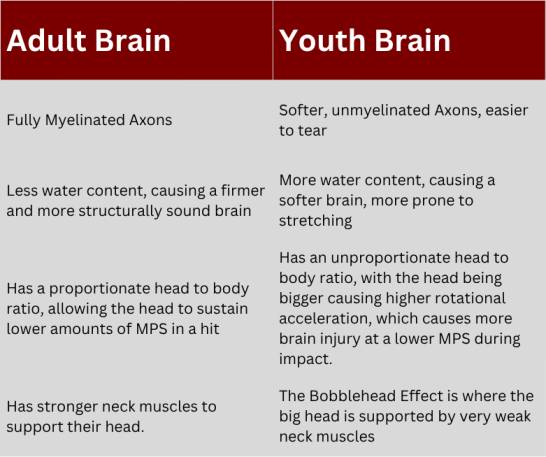
A table showing the differences between the adult's and child's brain
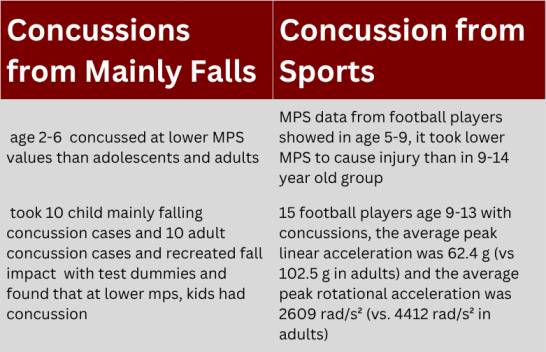
Concussions from different mechanisms can occur at lower MPS and impact in children
Video Presentation
Impact Statement

Ketan Manek
Participating in this program deepened my understanding of the human brain. Throughout the curriculum, I explored a wide range of neurological concepts, from the fundamentals of brain function to the science behind everyday processes like sleeping. We also analyzed clinical case studies and examined various neurodegenerative diseases and their pathology, providing me with an overview of the field of neuroscience. The culmination of this experience was the capstone project, which allowed me to apply my new knowledge to a real life situation and problem. For my project, I chose to investigate the neurological impacts of youth contact sports. Applying classroom concepts to a real-world safety issue not only solidified my academic understanding but also fueled my passion to continue studying how we can better protect developing brains in youth contact sports. This course improved my skills in research by teaching me how to search databases like PubMed, to find what articles I am using for my studies.
Student Reflection
By: Ketan Manek.