Nanotechnology & Drug Delivery
By: Kevin Morales-Ayala (Park View High School)
Summary
Nanotechnology has emerged as a promising innovation in the biomedical field. It came out with potential to improve drug delivery and advance precision medicine. As effective conventional drug delivery is, there are limitations. Poor drug stability, solubility, and limited targeting are all examples of the limitations conventional drug delivery faces. Since drugs can circulate the body to find its target, healthy tissues can be exposed to the drug which could cause unwanted side effects. This project investigates how nanoparticle based targeted drug delivery can overcome the limitations of conventional drug delivery.
The research examined how nanoparticles are used as drug carriers and the different types that can be used, including liposomes, polymeric micelles, dendrimers, nanocrystals, and silica nanoparticles. Nanoparticles can protect drugs from degradation, and transport them through the body and arrive at the target. Targeting can occur through passive mechanisms, where nanoparticles accumulate at diseased tissues naturally, or active mechanisms, where nanoparticles are modified with molecules such as ligands or antibodies to improve targeting. Once nanoparticles reach their site, the drug is released with control which increases drug exposure where it is needed and potentially reduces exposure to healthy tissues. There are also current applications of nanotechnology in areas including cancer treatment, neurodegenerative disease research, and the mRNA vaccine for Covid-19.
The findings show that nanoparticle based drug delivery has many advantages over conventional methods, including improved drug stability, controlled release, increased targeting, and reduced toxicity. However, there are challenges such as manufacturing, cost, regulatory approval, and long term safety. Recent research is developing multifunctional nanoplatforms which can combine multiple functions, such as drug delivery and diagnosis. Artificial intelligence is being investigated as a tool to improve nanoparticle design, drug loading, and release. Overall, nanotechnology has the potential to advance drug delivery and precision medicine by creating more controlled and targeted systems, but continued research is needed to address current limitations.
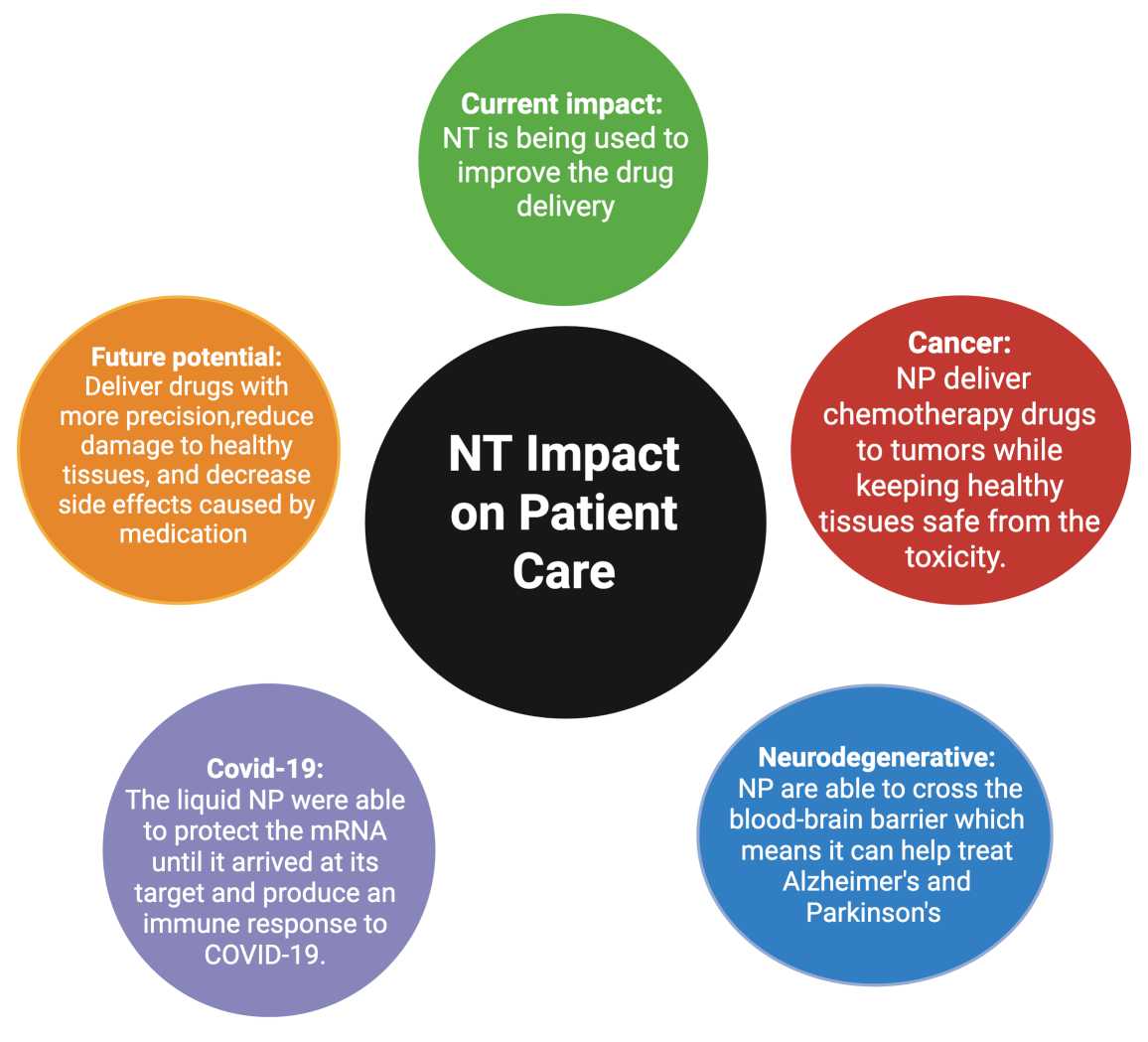
Nanotechnology impact on patient care
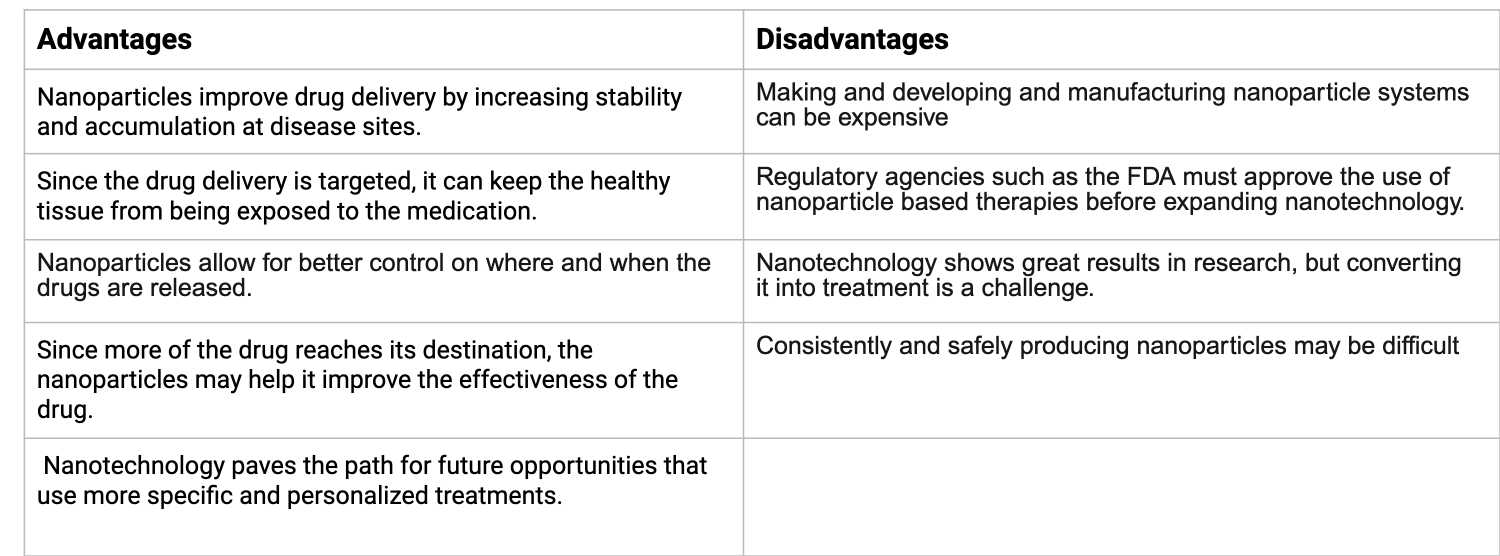
Advantages and disadvantages of nanoparticle drug delivery.
Video Presentation
Impact Statement

Kevin Morales-Ayala
This program has taught me an immense amount of information in a short period of time. I learned to focus on the mechanisms and concepts of the material instead of individual details. All of the information in the lessons were well thought out and taught amazingly. The research project has helped me develop skills that I will be able to use in future research. I learned to collect, evaluate, organize, and present information. Most importantly, this project has reinforced the importance of time management. Everything takes time and once you've wasted it you cannot get it back. There were still times of procrastination but in the end I was able to use my time effectively to complete this project. The accelerator program has prepared me for future research by giving me a stronger foundation in science and improved my research skills
Student Reflection
By: Kevin Morales-Ayala.