CRISPR Gene Editing For Beta-Thalassemia
By: Matthew Abdo (Crescenta Valley)
Summary
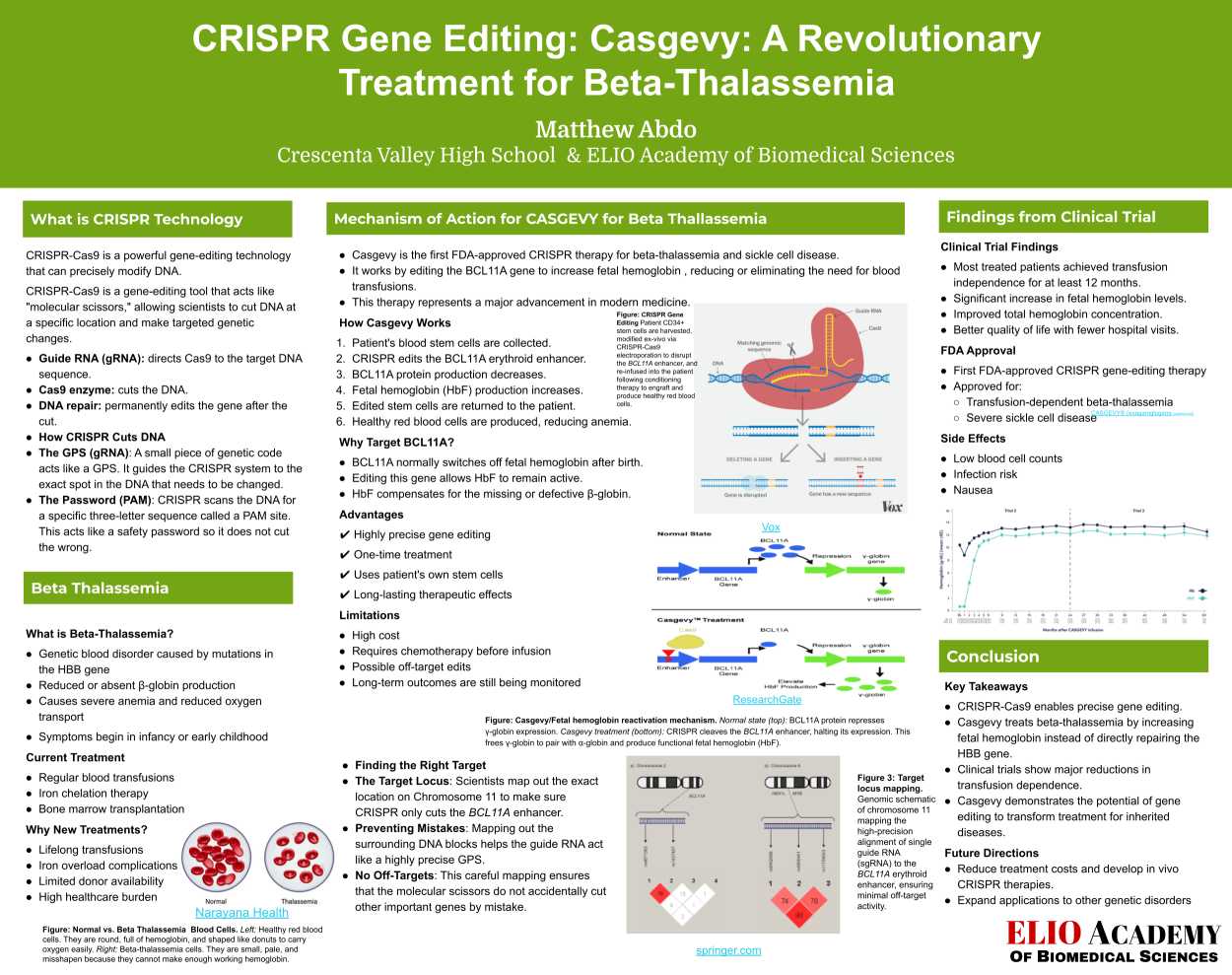
This project investigates the therapeutic efficacy and molecular mechanisms of Casgevy, a groundbreaking ex-vivo gene-editing therapy designed to treat transfusion-dependent beta-thalassemia. Beta-thalassemia is an inherited blood disorder characterized by genetic mutations that severely disrupt adult beta-globin synthesis. This genetic defect results in chronic microcytosis and widespread premature destruction of red blood cells, causing severe anemia. Traditionally, patients have relied on life-long blood transfusions, which trigger iron overload and toxic organ damage, or highly risky bone marrow transplants requiring a matching donor. This research evaluates a core hypothesis: utilizing the CRISPR-Cas9 system to precisely disrupt the erythroid-specific enhancer region of the BCL11A gene can permanently reactivate healthy fetal hemoglobin production, effectively bypassing the broken adult beta-globin genes and curing the disease.
The methodology highlights a sophisticated, four-stage clinical workflow to implement this genetic fix. First, patient-derived hematopoietic stem cells are harvested via apheresis. Second, these isolated cells undergo electroporation in a laboratory, exposing them to electrical pulses that temporarily permeabilize cell membranes to introduce CRISPR-Cas9 ribonucleoprotein complexes. Guided by a highly precise single-guide RNA mapping sequence, the Cas9 enzyme identifies the protospacer adjacent motif site, unwinds the DNA double helix, and executes a double-strand break to knock out the BCL11A genetic switch. Third, while cells are cultured, the patient undergoes conditioning therapy to clear out the bone marrow space. Finally, the edited stem cells are re-infused, allowing them to engraft and produce oxygen-rich fetal hemoglobin.
Analysis of primary clinical trial data confirms the project's hypothesis with exceptional scientific clarity. The treatment demonstrated an overwhelming 93.5% success rate, with 29 out of 31 evaluated beta-thalassemia patients achieving complete transfusion independence for a minimum of twelve consecutive months. Furthermore, parallel trials on sickle cell disease patients yielded an impressive 100% reduction in severe vaso-occlusive pain crises. By surgically silencing the BCL11A switch, the genetic brake on gamma-globin expression was successfully released, allowing it to pair with alpha-globin and form functional fetal hemoglobin. In conclusion, Casgevy represents a monumental shift in modern genetic medicine, transforming beta-thalassemia into a permanently curable disease.
Video Presentation
Impact Statement

Matthew Abdo
The bioresearch program was an amazing experience that changed how I see science. By studying a new treatment called Casgevy, I learned how advanced tools like CRISPR use molecular scissors to fix broken genes. I discovered that by turning off a genetic switch, scientists can help patients with beta-thalasemia make healthy red blood cells again. This showed me how real laboratory work can save people from painful, lifelong diseases. The program also helped me build importent skills for my future education. I learned how to read diffycult scientific articles, understand clinical trial charts, and explain complex biology concepts in simple ways. Succesfully mapping out how DNA works gave me a lot of personal confidence in my skills. Now, I feel totally ready for harder high school science classes and future collage lab work. This program proved to me that science is not just about memorizing facts from a textbook, but about solving real-world problems. It has inspired me to pursue a future career in biomedical engineering (mainly to be an endocrinologist).
Student Reflection
By: Matthew Abdo.