HSV-1 Reactivation in the Geniculate Ganglion as a Primary Trigger for Facial Nerve Inflammation in Bell’s Palsy
By: Max Almeida (Northern Valley Regional High School at Demarest)
Summary
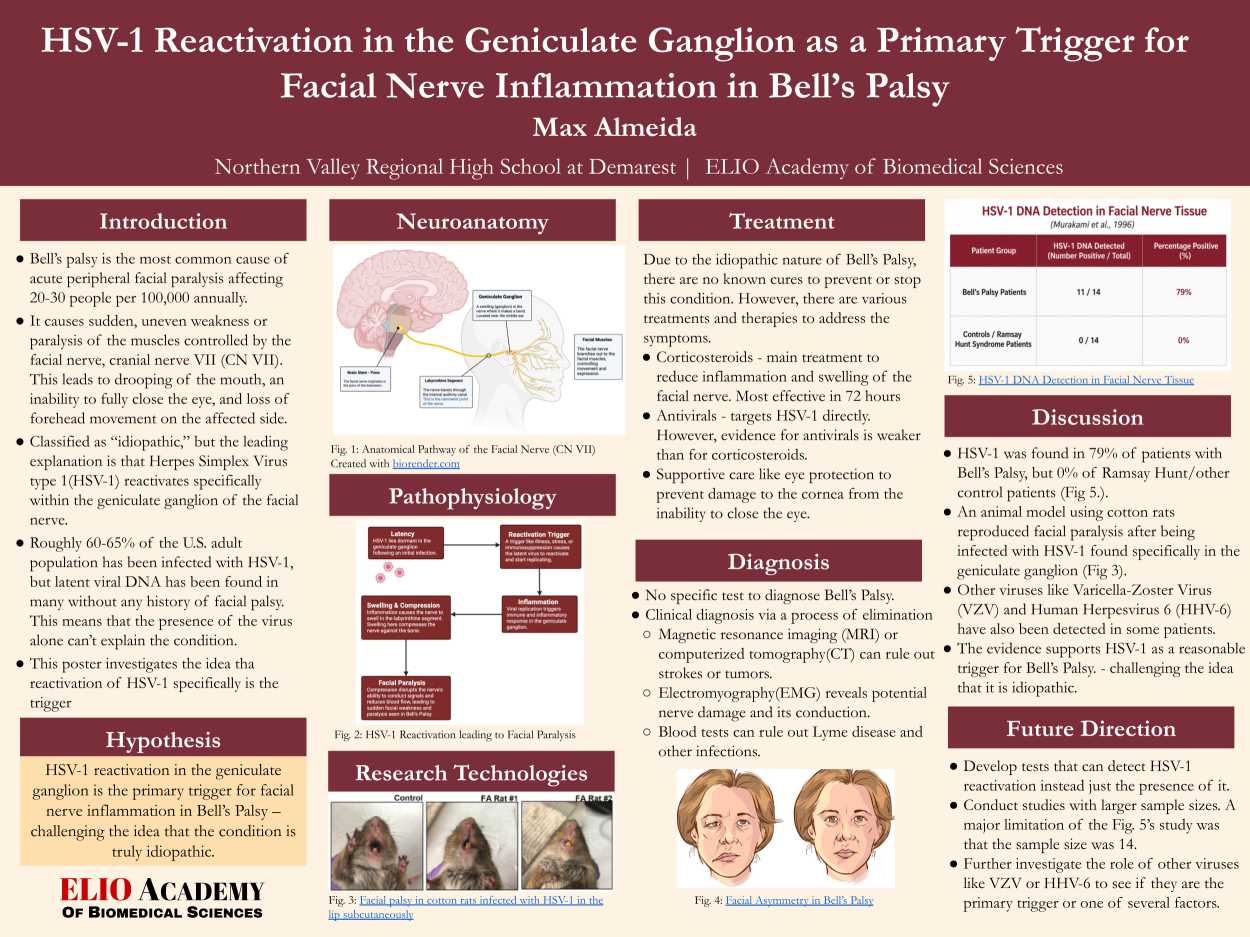
Bell's Palsy is the leading cause of acute facial paralysis, affecting 20 to 30 per 100,000 people yearly. It is considered idiopathic because doctors don't have any idea about its cause. This experiment investigated the possibility of discovering the actual cause of Bell's Palsy or determining if there is one that scientists just haven't proven yet. The initial hypothesis of the experiment stated that a virus known as HSV-1, which almost everyone has in their body without being aware of it, could be the reason for this phenomenon. The experiment checked if the activation of HSV-1 in the geniculate ganglion, a group of nerves located near the middle ear, leads to the inflammation of the facial nerve. Because of how tightly this nerve passes along that particular part of the skull, even slight inflammation may squeeze it, thus causing the paralysis observed in Bell's Palsy.
To test this idea, I researched and pulled together existing scientific studies to see if the evidence actually supported my hypothesis. One major study found HSV-1 in 79% of Bell's Palsy patients, but 0% of patients with a similar but different condition, which suggested the virus wasn't just randomly present, it was actually connected to this specific illness. I also looked at an animal study using cotton rats, where infecting them with HSV-1 directly caused facial paralysis, and the virus was found specifically where I expected it, in the geniculate ganglion. That gave me stronger evidence of cause and effect, not just a coincidence. Along the way, I also researched how doctors currently diagnose and treat Bell's Palsy, and looked into other viruses that might play a role too, so I could give a fair, balanced picture of the evidence.
In the end, I found real support for my hypothesis, but also real limitations, like small sample sizes in the research and the difficulty of proving reactivation in a living patient. This project taught me how to build a hypothesis, dig through real scientific research, and explain a complicated medical topic in a way that's actually understandable.
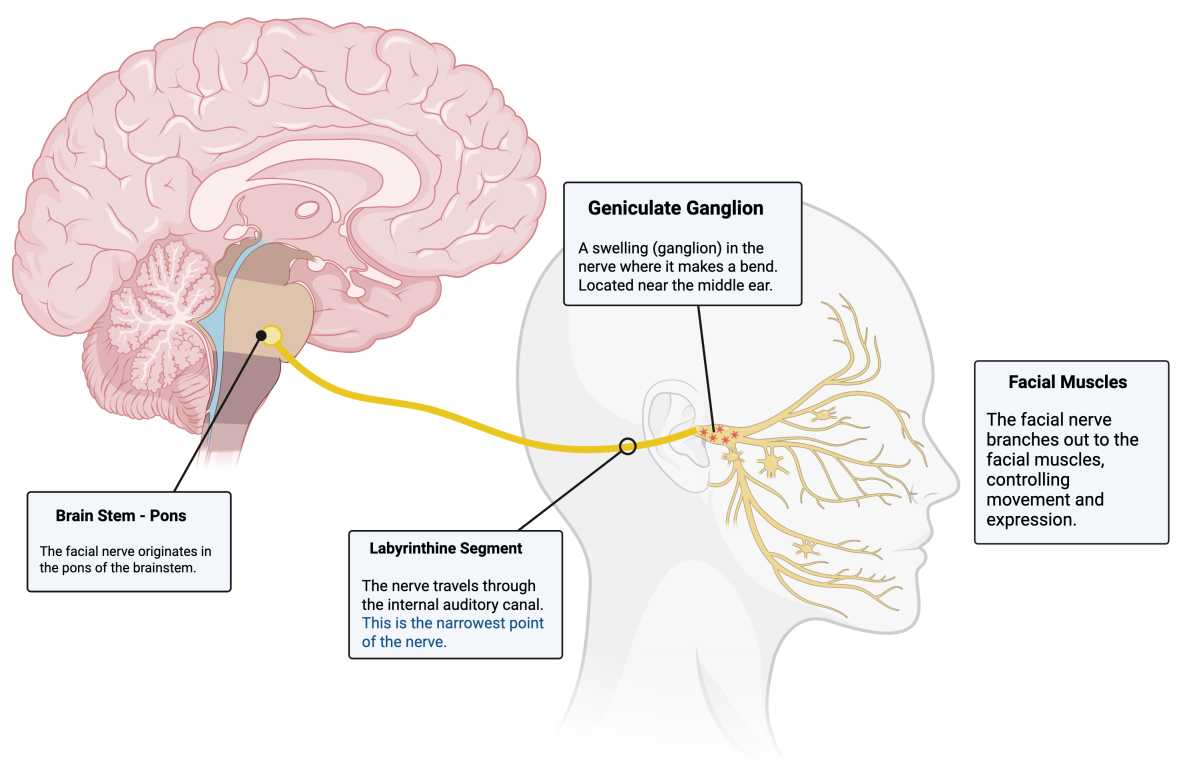
Anatomical Pathway of the Facial Nerve (CN VII)
Video Presentation
Impact Statement

Max Almeida
Taking this neuroscience program gave me a much better understanding of the principles of the brain system, how it coordinates with senses, and different neurological disorders. While learning the fundamentals of neuroanatomy and neural signaling, I gained the background to understanding complex diseases because of how they affect neuron communication, or brain structures. Through this program, I learned how to build a scientific poster project from the ground up. Starting with just a broad topic then taking that and narrowing it down to a specific, testable hypothesis. Researching Bell's Palsy taught me how to critically evaluate studies and organize my research findings. I had to separate strong data like the Murakami et al. study's PCR data, or the cotton rat image and data from weaker, less verifiable findings like the antiviral treatment. I had to present my findings clearly which greatly improved my communication skills in a scientific aspect. Overall, this program prepared me for future research by teaching me to think like a scientist and to present like one.
Student Reflection
By: Max Almeida.