Organ-on-a-Chip and In Vitro Testing
By: Sai Pranav Venkatesan (Conestoga High School)
Summary
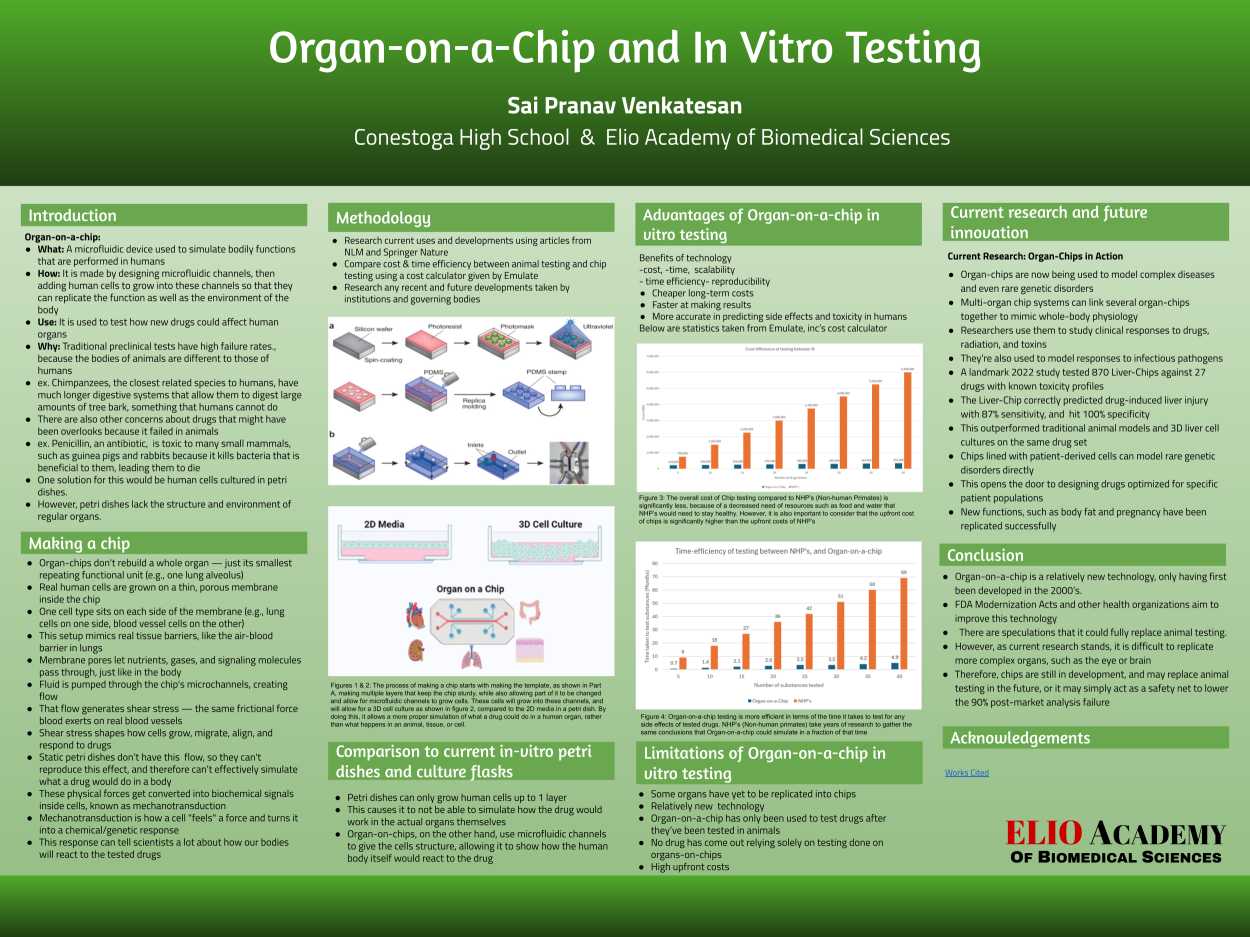
My project is about organ-on-a-chip, a microfluidic device that is used to simulate the smallest repeating unit of an organ, such as a lung alveolus, as well as its functions, such as blood flow and breathing. A chip's main purpose is to act to test drugs and see how it would affect a real human organ without testing on humans, and without relying on animals. The reason why scientists want to shift to alternatives to animal testing is because of the high post-market analysis failure rates, extending up to 90% in some cases over their lifetime. This is because animals are much different compared to humans. Even the closest relatives to humans have slightly differing organ systems.
To make one of these chips, human cells are grown onto a membrane, then using microfluidic channels, allows for blood flow and other functions. It also allows for mechanotransduction. There are other methods to in vitro testing, the most popular being the growing of cells in petri dishes and testing how drugs react with the cell. However, unlike chips, the cells grown in petri dishes could only show how drugs would react in the body on a tissue level, because the cells in petri dishes would only grow 1 cell thick. This is because of density dependent inhibition, where tissues cannot grow any thicker, unless they are cancerous, which wouldn’t provide uses in simulating organs.
There are many advantages to using organ-on-a-chip for in vitro testing. The long-term costs of running tests on organ-on-a-chip is much lower than running an experiment on NHP’s (Non-human primates), the closest animal relative to a human. Furthermore, chips can generate similar results to NHP’s in significantly less time. It is also easier to test more chips at once. It has been shown that certain chips, specifically the lung and liver chips, are very accurate. However, some organs have not fully been able to be developed into chips, specifically the brain and eye. High upfront costs have also been a deterrent to using chips. Even though the FDA has attempted to increase development to alternatives to animal testing through FDA modernization acts, and even removed the requirement of animal testing in 2022, it still is heavily biased towards animal testing, as it has been important evidence for decades. So far, chips have only been used as “safety nets,” but with future development, they could replace animal testing.
Video Presentation
Impact Statement

Sai Pranav Venkatesan
During the Elio Academy research program, I was given a major challenge: to research something new that I usually would have never thought about, organize it all into a rough document, compile all of that research into a singular poster, and then present it, all of this in around 2 weeks. I was shown many new resources in research that specifically focused on the biomedical field. It was something that I was shown recently and has given me plenty of information that I could use in the future for more research in other biomedical topics. Although I couldn’t use all the resources given to me due to there being no connection to my topic, it introduced me to those sources and could be used in topics I may research in the future. The program also helped me understand how to organize information in a way that could be easily understood and accessible to those who read it. I also developed multiple research habits, such as summarizing articles and extracting crucial information that could be easily digestible to someone who is somewhat new to a topic.
Student Reflection
By: Sai Pranav Venkatesan.